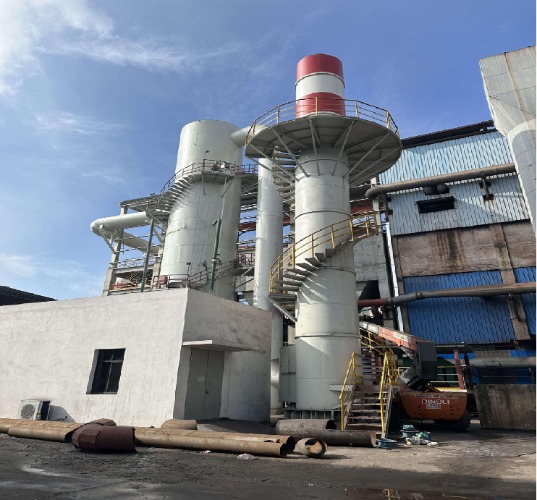
Industrial plants that burn fuel or calcine minerals release flue gas loaded with sulfur dioxide, nitrogen oxides, and fine particulate matter. For many years these pollutants were handled by a chain of separate equipment: a dust collector, a desulfurization absorber, and a denitrification reactor, each with its own ducts, fans, and control loops. A flue gas desulfurization and denitrification integrated tower takes a different approach by placing the sulfur and nitrogen removal stages inside one vessel. The result is a shorter gas path, fewer interconnecting ducts, and a smaller footprint.
The appeal is not only about space. Plants with tight construction windows often cannot afford long shutdowns for ductwork and foundation work, and owners with limited land need equipment that fits an existing layout. Integrated designs can also reduce the number of pressure-drop points in the system, which simplifies fan selection and can lower long-term electricity use.
Integration carries trade-offs. A combined vessel concentrates several chemical processes in one space, so temperature control, reagent distribution, and maintenance access must be planned with care. This guide walks through how these towers operate, which performance ranges are realistic, which variables drive cost, and where specifications most often go wrong. Readers will come away with a practical checklist for evaluating proposals.
How the four functional stages interact inside one vessel
Which performance figures are typical and what they depend on
How industry type and gas conditions change the configuration
Where operating costs and hidden project expenses come from
Key takeaway: an integrated tower replaces several separate units with a single engineered vessel. Its value depends on accurate inlet data, disciplined operation, and a specification that defines every scope item clearly.
How the Integrated Tower Operates
Although designs differ between suppliers and applications, most integrated towers move gas through four functional stages. Understanding each stage makes it easier to review a proposal and ask the right technical questions.
Gas inlet and conditioning. Hot flue gas enters through a distribution header designed to spread flow evenly across the cross-section. Temperature is adjusted, usually by spraying water or by mixing in cooler gas, so that the gas stays within the operating window of the sorbent and the catalyst.
Desulfurization zone. Alkaline sorbent, commonly a lime or limestone slurry in wet designs or a dry powder in semi-dry designs, contacts the gas. Sulfur dioxide is captured and converted into solid salts that are collected downstream.
Denitrification zone. A reducing agent is injected, and the gas passes through either a catalyst layer operating within a defined temperature band or a high-temperature reaction zone. Nitrogen oxides are converted into nitrogen and water vapor.
Mist removal and outlet. Entrained droplets and fine solids are removed by demisters, and the cleaned gas leaves through the outlet toward the stack or a downstream fan.
Residence time and even distribution matter as much as vessel size. A tower can be generously sized and still underperform if the gas channels along one wall and leaves pockets of untreated flow. Flow modeling during the design stage and distribution devices such as perforated plates or vane arrangements are therefore essential features rather than optional extras.
Why Temperature Windows Control Everything
The denitrification catalyst has an optimal temperature band. Below that band, reaction slows and unreacted reducing agent can escape as ammonia slip. Above it, the catalyst can degrade and some reagents decompose before they react. The desulfurization zone has its own limits: if the gas is too hot, sorbent drying outpaces capture, and if it is too cold, moisture can condense and form sticky deposits on internals. A sound design holds both windows at once, which is why the conditioning stage deserves close attention in any proposal.
Performance Benchmarks to Expect
Performance figures in proposals can look similar on paper while representing very different design margins. The table below gives general industrial reference ranges that can serve as a starting point before requesting guarantees tied to specific inlet conditions.
Parameter
Typical Range
Main Dependencies
Sulfur dioxide removal efficiency
90% to 98%
Sorbent type, reagent ratio, gas temperature
Nitrogen oxides removal efficiency
70% to 95%
Reducing agent, catalyst volume, temperature window
Outlet particulate concentration
Below 10 mg/Nm3
Upstream dust removal, demister design
Pressure drop across the tower
1500 to 3000 Pa
Gas velocity, internal layout, bed depth
Sorbent utilization
60% to 85%
Recirculation rate, particle size, mixing quality
These values are general ranges reported across many industrial applications. Actual guaranteed figures depend on inlet concentration, flow rate, temperature, and the permitted outlet limit, so a range alone should never be treated as a commitment.
What to Check in a Performance Guarantee
Whether the guarantee applies at maximum load, average load, or a defined minimum load
Which inlet concentrations are assumed, and whether the supplier will guarantee performance at higher values
How the reagent ratio is defined and whether consumption is guaranteed together with efficiency
What outlet behavior is expected during start-up, shutdown, and upset conditions
Who performs the acceptance test, and which measurement standard governs the results
Matching the Configuration to Your Industry
The same integrated tower concept can be configured in very different ways depending on the source of the flue gas. Four sectors show distinct patterns that influence design choices, and understanding them helps buyers judge whether a proposal reflects real experience.
Lime Kilns
Lime kiln gas often carries high sulfur dioxide concentrations because of fuel sulfur content and the calcination process itself, and it usually arrives with significant dust. Designs therefore prioritize robust sorbent handling and efficient dust pre-treatment. Kiln output fluctuates with production schedules, so the tower needs a turndown range that keeps removal stable at reduced throughput.
Cement Production Lines
Cement kiln gas is typically high in volume and carries substantial nitrogen oxides formed in the high-temperature burning zone. Ultra-low emission requirements in many regions push these projects toward catalytic denitrification with carefully controlled reagent injection. Integration is attractive here because it reduces total ducting length across a large system and simplifies the control architecture.
Industrial Boilers
Boilers vary widely in size and fuel type. Smaller units often pair semi-dry desulfurization with selective non-catalytic reduction, which avoids a catalyst bed but depends heavily on temperature control and reagent mixing. Owners of older boilers frequently find that an integrated retrofit fits within existing structures better than a series of new standalone units.
Metallurgical Furnaces
Furnace gas can contain metallic vapors, fine particles, and composition swings during batch cycles. Projects in this sector call for careful characterization of the gas over a full operating cycle rather than a single snapshot. Designs often add corrosion protection, wider access doors for cleaning, and more conservative velocity limits.
Operating Cost Drivers
Capital cost receives most of the attention in purchasing discussions, but operating expenses accumulate over many years and often determine the true cost of ownership. Several recurring items account for most of the budget, and each responds to design and operating decisions.
Sorbent consumption. Sorbent is usually the largest recurring expense. Consumption rises with sulfur loading and falls with better gas-sorbent contact, which is why recirculation and particle size control matter so much.
Reducing agent consumption. Ammonia or urea use depends on the nitrogen oxides load and the target removal rate. Excess injection increases cost and can create ammonia slip, which becomes a secondary emission concern.
Catalyst replacement. Where catalytic denitrification is used, catalyst life spans several years before activity declines enough to require replacement. Service life depends on dust loading, temperature history, and poisoning from trace components.
Electricity. Fans, slurry pumps, and mixers draw continuous load. Lower pressure drop across the tower reduces fan energy over the life of the plant, so resistance should be part of every comparison.
Water and waste handling. Wet systems produce byproduct solids and may generate wastewater that requires treatment. Dry and semi-dry options shift cost away from water management and toward sorbent use and solid disposal.
Maintenance labor and spare parts. Nozzles, demisters, and instruments need periodic attention. Access design and standardized components can shorten labor time during scheduled outages.
A practical way to compare options is to calculate annual operating cost for each configuration using the same inlet data, the same availability assumption, and the same electricity tariff. Proposals that appear cheaper at purchase can become more expensive once these recurring items are included over a realistic project life.
Installation and Site Considerations
A tower that meets every performance target on paper can still cause delays if the site was not evaluated thoroughly. Four factors deserve early review, and each can shift the project budget in ways that are easy to miss during initial comparisons.
Foundation and Structural Load
The vessel, slurry tanks, and reagent silos transfer significant loads to the foundation. Soil conditions, seismic requirements, and wind loading all influence civil design. Civil work often represents a meaningful share of installed cost, and some proposals exclude it entirely, leaving the buyer to source it separately.
Fan Compatibility
Every added bed, nozzle layer, and demister increases system resistance. Before committing to a configuration, check whether the existing induced draft fan has enough margin. If it does not, fan replacement or modification must be added to the project scope, along with the motor and electrical upgrades that may follow.
Ducting, Insulation, and Corrosion Protection
The length and routing of ducts between the source and the tower affect heat loss, condensation risk, and material selection. Gas containing sulfur or fluoride compounds often requires lined or fiber-reinforced protection, which costs noticeably more than standard carbon steel. Insulation quality directly affects whether the gas stays inside the correct temperature window when it reaches the tower, and an integrated tower design should be evaluated together with its ducting, not in isolation.
Commissioning and Acceptance
Commissioning should follow a defined test program, preferably with third-party measurement. Agree in advance on test duration, sampling locations, measurement methods, and whether the trial includes a period under real production load. Clear acceptance criteria prevent disputes after the equipment is already in operation.
Common Specification Mistakes
Many underperforming projects trace back to a small number of recurring errors. Avoiding them during specification is usually far cheaper than correcting them after installation.
Using Average Inlet Data Only
Average flue gas conditions hide peaks. Specify design values for maximum concentration and maximum flow, and confirm that the equipment can handle them without exceeding outlet limits.
Ignoring Start-Up and Upset Conditions
Emissions often spike during start-up or when fuel quality changes. The specification should define acceptable emission behavior during these periods and the control measures that limit it.
Comparing Quotations With Different Scopes
One proposal may include foundations, fans, and commissioning while another leaves them out. Normalize quotations by listing every scope item side by side before comparing totals.
Underestimating Reagent Logistics
Storage capacity, unloading equipment, and preparation systems for sorbent or reducing agent require space and labor. Omitting them can leave a sound tower without a practical way to operate day to day.
Maintenance and Long-Term Reliability
Reliable operation depends on a maintenance plan matched to the process. The chart below shows a typical distribution of planned maintenance effort across major subsystems in a mid-sized installation. The figures are illustrative and will vary with design and operating conditions.
Routine practices that make the largest difference include regular nozzle inspection, scheduled demister washing, calibration of reagent feed controls, and trend monitoring of pressure drop. Pressure drop trends in particular give early warning of deposits or partial blockages before they affect emission performance, and they are inexpensive to track with existing instrumentation.
Spare parts strategy also matters. Keeping critical nozzles, pump seals, and sensor components on site shortens unplanned outages, while documenting inspection intervals in the maintenance system keeps the plan visible to operators and management alike.
Frequently Asked Questions
Q1: How is the removal efficiency of an integrated tower measured?
Efficiency is determined by comparing pollutant concentrations at the inlet and the outlet under the same operating conditions, using a recognized sampling method. Because inlet concentrations fluctuate, results are usually reported as averages over a defined period, and the test should record load and temperature alongside the emission data.
Q2: Can an integrated tower be retrofitted into an existing plant?
Retrofits are common, especially when the existing layout allows one tower to replace several older units. Feasibility depends on available space, the margin of existing fans, and how much ducting must be rerouted. A detailed site survey is the most reliable way to confirm whether a retrofit is practical.
Q3: What determines whether a dry or wet configuration is better?
The choice depends on water availability, byproduct handling options, sulfur loading, and the required outlet limit. Wet processes typically achieve high removal efficiency but require wastewater treatment. Dry and semi-dry processes avoid liquid discharge but may consume more sorbent to reach the same result.
Q4: How long does catalyst last in the denitrification zone?
Catalyst life varies widely and often falls within a range of several years. Dust loading, operating temperature, and trace poisons in the gas are the main factors. Regular activity testing allows operators to plan replacement in advance rather than reacting to emission exceedances.
Q5: Is it possible to start with desulfurization and add denitrification later?
Phased projects are possible when the initial design leaves room for future reaction zones and reagent systems. Planning the layout early avoids costly modifications later. Owners should confirm with the supplier which components are reusable and which would need replacement during the expansion.



 English
 Français
 عربى
 简体中文