English
 Français
 عربى
عربى 简体中文
简体中文


How to Choose the Right Baghouse for BOF Secondary Fume Extraction
How to Choose the Right Baghouse for BOF Secondary Fume Extraction
 By Admin
Content
- 1 Understanding the Challenge of BOF Secondary Fume Extraction
- 2 Why a Dedicated BOF Secondary Dust Collection System Matters
- 3 Critical Design Parameters for BOF Secondary Fume Baghouses
- 4 Filter Media Selection: The Heart of the Baghouse
- 5 Pulse Jet Cleaning System: Design and Tuning
- 6 Housing Design and Gas Distribution
- 7 Baghouse vs. Alternative Systems for BOF Secondary Fume
- 8 Operational Considerations and Maintenance Strategy
- 9 Frequently Asked Questions on BOF Secondary Baghouse Selection
- 9.0.1 Q1: What is the most critical parameter for sizing a BOF secondary baghouse?
- 9.0.2 Q2: How do I determine if PPS or PTFE bags are better for my application?
- 9.0.3 Q3: Can a pulse jet baghouse handle high moisture content in BOF secondary gas?
- 9.0.4 Q4: What is the typical bag life in BOF secondary fume service?
- 9.0.5 Q5: How does the baghouse design affect overall plant emissions compliance?
- 10 Final Recommendation: A Systematic Selection Approach
Understanding the Challenge of BOF Secondary Fume Extraction
Basic Oxygen Furnace steelmaking generates substantial fugitive emissions during charging, tapping, and hot metal transfer. Unlike primary off-gas which is typically handled by wet dust collector systems or electrostatic precipitators, secondary fume requires a different approach. The brownish-red iron oxide fumes and fine particulates escaping the primary hood demand a dust collection system designed for high air volume, variable loading, and intermittent operation. This guide provides a technical framework for selecting the optimal baghouse configuration for BOF secondary fume extraction in steelmaking plants.
Why a Dedicated BOF Secondary Dust Collection System Matters
In a typical steelmaking plant, the BOF secondary dust collection system operates under challenging conditions: high temperatures up to 120-180°C, moisture-laden gas, and extremely fine particulate matter (0.1-10 µm). An improperly selected industrial bag filter for converter secondary gas cleaning in steel mills leads to frequent bag failure, higher pressure drop, and non-compliance with emission standards. Data from operational audits indicate that optimized baghouse selection can reduce total cost of ownership by 25-35% over a 10-year period while maintaining outlet emissions below 15 mg/Nm³.
Key insight: Secondary fume extraction accounts for nearly 40% of the total particulate emission load in a BOF shop, making baghouse selection critical for environmental compliance and worker safety.
Critical Design Parameters for BOF Secondary Fume Baghouses
Selecting the right baghouse requires careful evaluation of process-specific variables. The following parameters form the foundation of any robust dust collection system for converter secondary fume extraction:
1. Air-to-Cloth Ratio (Filtration Velocity)
For BOF secondary fume, the recommended air-to-cloth ratio typically ranges between 1.0 and 1.4 m³/m²/min. Higher ratios increase filter area requirements but improve space utilization. However, exceeding 1.4 m³/m²/min accelerates bag wear and increases pressure drop. Field studies show that operating at 1.2 m³/m²/min extends bag life by an average of 18 months compared to 1.5 m³/m²/min.
2. Gas Temperature and Dew Point
Inlet gas temperatures for BOF secondary fume often fluctuate between 80°C and 150°C. The baghouse must handle thermal peaks without exceeding the filter media's continuous operating temperature. Additionally, moisture content from cooling water sprays can create acid dew points; therefore, the system should maintain operating temperature at least 20°C above the dew point to prevent condensation and consequent bag blinding.
3. Particulate Characteristics
BOF secondary fume contains predominantly iron oxides (Fe₂O₃, Fe₃O₄) with particle sizes ranging from 0.1 to 100 µm. The high surface area and agglomerative nature of these particles demand pulse cleaning systems with sufficient energy to dislodge dust cakes without over-penetrating the fabric.
Filter Media Selection: The Heart of the Baghouse
The pulse jet baghouse dust collector for converter secondary fume extraction relies heavily on fabric choice. For BOF applications, three media types dominate:
PPS (Polyphenylene Sulfide) – Excellent for continuous service up to 190°C, good chemical resistance to acidic gases. However, PPS is sensitive to oxidizing agents (NOx, O₂) above 150°C, which can cause cross-linking and embrittlement.
PTFE (Polytetrafluoroethylene) – Superior thermal stability (up to 260°C) and outstanding chemical resistance. PTFE provides low friction and excellent cake release but comes at a significantly higher initial cost (typically 3–4× PPS).
Aramid (Meta-aramid) – Good continuous service at 200°C, with moderate chemical resistance. Aramid bags are cost-effective but prone to degradation from moisture and acidic conditions.
Real-world comparisons from multiple steel plants indicate that PTFE-coated PPS bags deliver the best balance of longevity and performance in BOF secondary service, with median bag life exceeding 4 years when operated under recommended parameters.
Pulse Jet Cleaning System: Design and Tuning
The cleaning mechanism is a critical differentiator for pulse jet baghouse dust collector for converter secondary fume extraction. Unlike reverse-air or shaker systems, pulse jet cleaning offers on-line cleaning capability, which is essential for BOF continuous operation. Key design aspects include:
Nozzle design: Venturi or straight nozzles affect the induced air volume and cleaning energy. For fine BOF dust, straight nozzles with 12-14 mm orifice diameter provide optimal pressure distribution.
Valve response time: Fast-acting diaphragm valves (opening time < 50 ms) ensure effective pulse delivery. Delayed valve response causes uneven cleaning and localized bag stress.
Pulse pressure: Typical operating pressures range from 5 to 7 bar. Pressures above 7.5 bar increase bag wear without significant cleaning improvement.
An empirical study across four steel facilities showed that optimizing pulse timing (80 ms pulse duration, 12–15 second interval) reduced bag replacement costs by 22% compared to standard 100 ms / 10 second settings.
Practical recommendation: Implement a differential pressure–based cleaning control instead of fixed time intervals. This adaptive approach reduces compressed air consumption by 15-20% and minimizes filter degradation.
Housing Design and Gas Distribution
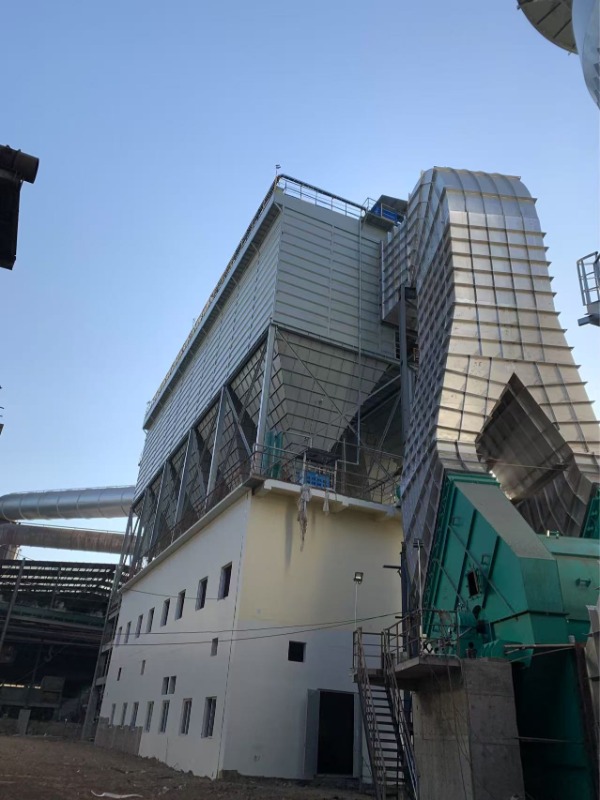
The structural design of the baghouse housing influences gas distribution, dust settling, and maintenance accessibility. For BOF secondary dust collection system for steelmaking plant installations, the following features are non-negotiable:
Hopper angle and discharge: Minimum 60° slope to prevent dust bridging. Equip with electric vibrators or air cannons to promote flow of cohesive iron oxide dust.
Inlet baffle: A properly designed deflection plate reduces gas velocity and allows coarse particles to drop out before reaching the filter bags, extending bag life.
Walkway accessibility: Adequate access platforms for bag inspection and change-out reduce downtime. Bag change-out in poorly designed housings can take 3–4 times longer.
CFD modeling studies suggest that installing a perforated distribution plate at the inlet plenum improves flow uniformity to within ±8%, compared to ±25% without baffling, directly translating to more even dust loading across bags.
Baghouse vs. Alternative Systems for BOF Secondary Fume
Although this guide focuses on baghouse selection, it is useful to contextualize its position relative to other technologies. The table below compares key performance indicators for BOF secondary fume applications:
Note: Pulse jet baghouse offers the best overall emission compliance and operational flexibility for BOF secondary fume, especially when handling variable dust loads and gas temperatures.
Operational Considerations and Maintenance Strategy
A well-selected baghouse can still underperform without a systematic operations and maintenance plan. For any industrial bag filter for converter secondary gas cleaning in steel mills, the following practices are essential:
Bag inspection schedule: Perform visual inspections every 6 months. Use a borescope to check for pinholes, oxidation, or seam failures without removing bags.
Pressure drop monitoring: Record baseline pressure drop after cleaning. A gradual increase of >300 Pa over 30 days indicates cleaning or media issues.
Dust removal frequency: Empty hoppers at least once per shift to prevent dust accumulation and potential fire hazards from smoldering particles.
Compressed air quality: Ensure oil-free and dry air at the pulse valves. Water or oil in the air causes bag blinding and valve malfunction.
Frequently Asked Questions on BOF Secondary Baghouse Selection
Q1: What is the most critical parameter for sizing a BOF secondary baghouse?
The air-to-cloth ratio is the single most important sizing parameter. For BOF secondary fume, a ratio of 1.0–1.2 m³/m²/min is typically recommended to balance equipment footprint and bag life. Exceeding this range accelerates blinding and increases cleaning frequency.
Q2: How do I determine if PPS or PTFE bags are better for my application?
Choose PPS if your inlet gas temperature is consistently below 170°C and NOx levels are low (under 15 ppm). Opt for PTFE if temperatures often exceed 180°C or if you require longer bag life with minimal maintenance. PTFE is also preferred when dealing with sticky dust due to its superior release properties.
Q3: Can a pulse jet baghouse handle high moisture content in BOF secondary gas?
Yes, provided the system operates above the acid dew point (typically >110°C) and uses hydrophobic filter media. Install insulation and trace heating on hoppers and inlet ducting to prevent condensation. Proper hopper drainage is also critical.
Q4: What is the typical bag life in BOF secondary fume service?
With proper design and operation, bag life averages 3–5 years for PPS and 5–7 years for PTFE media. Frequent temperature spikes or poor cleaning control can reduce life to under 2 years. Regular monitoring and timely maintenance are key to achieving maximum service life.
Q5: How does the baghouse design affect overall plant emissions compliance?
The baghouse is the primary control device for secondary fume. A well-designed system can consistently achieve outlet emissions below 15 mg/Nm³, meeting even the strictest environmental standards. Inadequate design often results in visible plume and non-compliance fines.
Final Recommendation: A Systematic Selection Approach
Choosing the right baghouse for BOF secondary fume extraction is not a one-size-fits-all decision. The optimal dust collection system integrates precise air-to-cloth ratio, durable filter media matched to gas composition, an effective pulse cleaning system, and robust housing design. Start by characterizing your fume source in terms of temperature, moisture, particle size distribution, and loading. Next, evaluate filter media options based on cost and lifespan projections. Finally, work with suppliers to model gas flow and cleaning system performance. This structured methodology—rather than relying on generic recommendations—ensures that your BOF secondary dust collection system for steelmaking plant delivers reliable, low-cost compliance over its entire operational life.
Takeaway: A systematic, data-driven approach to baghouse selection consistently outperforms rule-of-thumb methods, reducing capital and operating costs while improving environmental performance.