English
 Français
 عربى
عربى 简体中文
简体中文


Understanding the Components of Electrostatic Precipitators: A Comprehensive Breakdown
HOME / NEWS / Industry News / Understanding the Components of Electrostatic Precipitators: A Comprehensive Breakdown
 By Admin
Content
Industrial facilities worldwide generate millions of tons of particulate matter annually, from dust and smoke to fine ash and metallic particles. Managing this pollution is not merely an environmental concern—it directly impacts operational efficiency, regulatory compliance, and long-term facility viability. Among the most effective technologies for addressing this challenge is the electrostatic precipitator, a sophisticated system that has evolved over more than a century to become an indispensable component in heavy manufacturing, power generation, and chemical processing.
Understanding the technical architecture of these systems enables facility managers and engineers to optimize performance, reduce operational costs, and make informed decisions about maintenance and upgrades. This guide examines the fundamental components, operational principles, and practical considerations that define modern electrostatic precipitator technology.
An electrostatic precipitator operates through a deceptively simple yet highly effective principle: particles suspended in airflow are charged electrostatically, then collected on oppositely charged surfaces. Despite this fundamental simplicity, the execution involves precise engineering and coordinated subsystems working in concert.
The process begins in the ionization region, where gas molecules are bombarded with high-energy electrons. A negative potential—typically ranging from 40,000 to 100,000 volts—creates an intense electric field that strips electrons from neutral gas molecules, generating ions. These newly created negative ions collide with suspended particles, transferring their charge. The efficiency of this charge transfer depends on several factors: particle size and composition, gas velocity, moisture content, and electrode configuration.
Smaller particles present a particular challenge in ionization. Particles smaller than one micrometer are more difficult to charge effectively because they have less surface area available to receive electrons. However, modern ESP designs have substantially improved ionization efficiency for ultrafine particles through optimized electrode spacing and current modulation.
Once charged, particles migrate toward collection plates—typically flat or tubular metal surfaces maintained at ground potential or a positive charge opposite to the particles. The electric field provides the driving force for this migration. Residence time in the collection zone is critical; insufficient time results in particles exiting with the treated gas, while excessive residence time increases capital costs without proportional efficiency gains. Most industrial systems achieve particle residence times between 5 and 20 seconds.
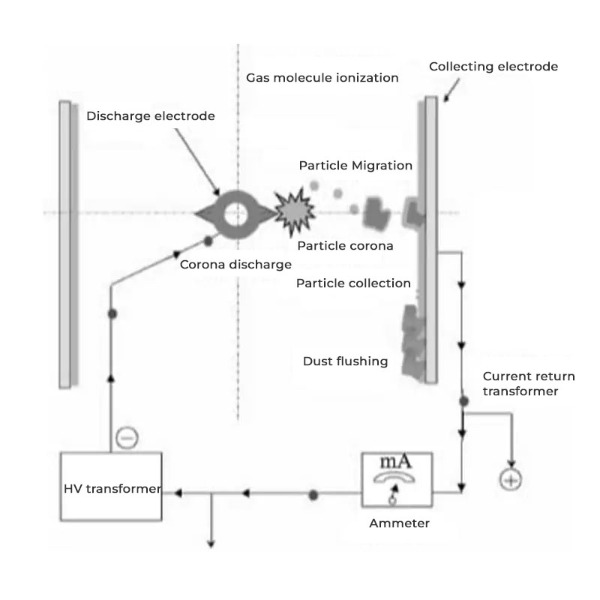
A fully functional electrostatic precipitator comprises multiple integrated subsystems. Each component serves a distinct function, and failure in any single component can compromise the entire system's performance.
Discharge electrodes create the intense electric field necessary for particle ionization. These electrodes come in several configurations, each with distinct advantages and operational characteristics:
Wire electrodes: Thin wires suspended vertically maintain high current density in localized regions, creating strong ionization zones
Rod electrodes: Thicker than wires, providing greater mechanical stability and reduced corrosion vulnerability
Spike electrodes: Featuring sharp points that enhance localized field strength, useful for high-resistivity dust applications
Bar electrodes: Rectangular cross-sections offering intermediate characteristics between wires and rods
Wire electrodes remain the most common choice in modern systems due to their superior current distribution and proven operational reliability. However, they require more frequent inspection and maintenance than alternative configurations. The selection between electrode types depends on dust characteristics, gas composition, required collection efficiency, and maintenance capacity.
Collection plates constitute the largest single component by surface area in most electrostatic precipitator designs. Charged particles migrate to these plates and adhere through electrostatic attraction combined with intermolecular forces. Collection plate configurations include:
Flat plate configuration: Parallel vertical plates creating uniform electric field with maximum accessible surface area
Tubular configuration: Cylindrical tubes providing radial collection surfaces with compact footprints
Rod-in-tube configuration: Discharge electrodes centered within collection tubes for enhanced field optimization
Plate spacing typically ranges from 150 to 400 millimeters, balancing electric field strength against dust layer formation and operational complexity. Wider spacing reduces electrode cleaning frequency but slightly diminishes collection efficiency. Narrower spacing improves efficiency but requires more frequent maintenance and poses greater risks of electrical arcing.
As charged particles accumulate on collection plates, they gradually form dust layers. Excessive accumulation degrades electric field strength and reduces collection efficiency. Mechanical removal mechanisms prevent this degradation:
Rapping mechanisms: Mechanical vibrators strike collection plates at controlled intervals, dislodging accumulated dust
Electrode cleaning systems: Secondary rapping mechanisms specifically target discharge electrodes to prevent bridging
Hoppers: Conical or pyramidal structures beneath collection plates channel falling dust toward discharge outlets
Dust unloading equipment: Augers, rotary airlocks, or pneumatic systems transport collected dust to external handling facilities
The frequency and intensity of rapping cycles significantly impact operational performance. Insufficient rapping allows excessive dust accumulation; excessive rapping generates noise, increases mechanical wear, and can re-entrain particles back into the gas stream. Modern systems employ feedback sensors to optimize rapping schedules based on real-time stack opacity measurements.
Maintaining the required electric potential represents a fundamental operational requirement. High-voltage power supplies serve several critical functions:
Voltage generation: Transformers step up facility power from thousands of volts to tens of thousands of volts
Current regulation: Secondary voltage control maintains optimal operating current while preventing excessive arcing
Arc detection and suppression: Rapid response circuits identify electrical arcing events and instantly reduce voltage to prevent equipment damage
Power factor correction: Capacitive loads inherent in precipitator design require compensation for stable long-term operation
Modern power supplies incorporate sophisticated digital controls that continuously optimize voltage and current parameters based on load conditions. These systems can automatically compensate for temperature fluctuations, gas composition variations, and dust load changes, improving collection efficiency and reducing energy consumption compared to earlier fixed-parameter designs.
Effective particle collection depends critically on uniform gas distribution across the collection zones. Poorly distributed gas creates dead zones with minimal collection efficiency. Inlet design considerations include:
Flow velocity: Typically maintained between 0.5 and 1.5 meters per second, balancing residence time against dust re-entrainment
Velocity distribution: Specialized inlet designs minimize variations across the cross-section to ensure uniform residence time
Turning vanes: Internal elements in curved ductwork smooth gas transitions and reduce turbulence
Gas conditioning equipment: Cooling systems, humidification units, or mixing chambers adjust gas properties for optimal collection
Clean gas exits the precipitator through outlet ductwork equipped with:
Opacity monitoring systems: Real-time sensors measure stack emissions and trigger alarms for performance degradation
Induced draft fans: Maintain necessary airflow and overcome system pressure drops
Exit filters: Polishing filters may supplement precipitation in applications requiring exceptionally low emission rates
Two primary design philosophies dominate industrial air pollution control, each with distinct technical and operational characteristics.
Dry systems collect particles on solid collection surfaces without liquid media. This configuration dominates general industrial applications for several fundamental reasons:
Simplicity: Mechanical design is straightforward, with minimal auxiliary systems required
Particle recovery: Collected dust can be readily recovered and recycled in many industrial processes
Operational efficiency: Lower energy requirements for fan systems compared to liquid-handling alternatives
Maintenance accessibility: Internal components are easily inspected and serviced
However, dry systems face limitations with sticky, hygroscopic, or highly corrosive particles that can bridge across collection plates or corrode metallic surfaces.
The wet electrostatic precipitator (WESP) represents a specialized evolution addressing limitations of dry systems. Originally developed for metallurgical industry applications, WESP technology has expanded into chemical processing, petroleum refining, and specialty manufacturing. Key operational characteristics include:
Liquid spray systems: Water or specially formulated solutions continuously coat collection surfaces
Particle suspension: Liquid film suspends collected particles, preventing surface bridging and enabling removal through liquid drainage
Corrosion protection: Liquid media shields metallic collection surfaces from corrosive gas components
Enhanced efficiency: Liquid wetting properties can improve particle adhesion and collection efficiency for challenging dust types
The wet electrostatic precipitator for metallurgical industry applications has demonstrated particular value in scenarios involving sinter plant emissions, casting operations, and secondary metal processing, where severe particle composition challenges make dry collection problematic. However, WESP systems introduce operational complexity through wastewater handling requirements, chemical consumption costs, and more intricate maintenance procedures.
The following table presents key comparison metrics between dry and wet configurations:
| Performance Metric | Dry ESP | Wet ESP |
|---|---|---|
| Collection Efficiency | 94-99% | 95-99.5% |
| Energy Consumption | Baseline | 15-25% Higher |
| Particle Recovery | Excellent | Limited |
| Maintenance Frequency | Moderate | Higher |
| Corrosive Gas Handling | Challenging | Superior |
| Sticky Particle Handling | Problematic | Effective |
The characteristics of the gas stream fundamentally influence electrostatic precipitator performance. Temperature, moisture content, and gas composition create conditions that either enhance or inhibit efficient particle collection.
Temperature regulation represents a primary operating concern. Most electrical discharge mechanisms perform optimally between 120 and 180 degrees Celsius. Temperatures below this range increase electrical resistivity, potentially causing voltage breakdown. Excessive heat degrades insulation materials and increases component corrosion rates. Gas cooling or heating equipment maintains optimal temperature conditions, often as an integral component of modern industrial installations.
Moisture content dramatically affects dust electrical properties. Humidity levels between 8 and 12 percent optimize particle charge retention and collection efficiency in many applications. Excessively dry conditions create static electricity problems and reduce particle adhesion. Excessive moisture can cause dust bridging and electrical arcing. Humidity control systems actively maintain target moisture ranges through steam injection or conditioning equipment.
Resistance to gas flow through the electrostatic precipitator system necessitates supplementary fan capacity. Pressure drop typically ranges from 250 to 500 pascals under normal operating conditions. This resistance arises from several sources:
Electrode geometry: Electric field regions inherently create resistance to airflow
Dust accumulation: Progressive dust layer buildup increases resistance over rapping cycles
Inlet and outlet configurations: Ductwork design contributes additional resistance
Induced draft fans must overcome this resistance while maintaining target gas velocity through collection zones. Fan power requirements directly impact operational electricity costs. Modern systems employ variable frequency drive fans that adjust speed based on actual pressure drop measurements, reducing unnecessary power consumption during periods of lower dust loading.
Electrical resistivity of collected dust significantly influences collection mechanisms. High-resistivity dusts, typical of fly ash from coal combustion or aluminum smelter emissions, present particular operational challenges. Particles accumulate excessive electrical charge while on collection plates, creating repulsive forces that resist adhesion. This "back corona" effect can reduce collection efficiency from 95 percent to 60 percent or lower in untreated high-resistivity applications.
Mitigation strategies include:
Electrical resistivity reduction: Sulfur trioxide or conditioning chemicals alter dust surface properties
Moisture adjustment: Increased humidity reduces resistivity through surface charge leakage
Temperature optimization: Modified operating temperatures shift resistivity characteristics
Specialized electrode configurations: Improved field geometry compensates for resistivity effects
Particle size represents one of the most influential factors determining collection efficiency. The relationship is non-linear and creates both optimal collection zones and problematic size ranges:
Ultrafine particles (below 1 micrometer): Difficult to charge effectively, but once charged, very effective collection occurs
Fine particles (1-10 micrometers): Most efficiently collected across standard operating conditions
Coarse particles (above 10 micrometers): Readily charged and quickly collected
Applications generating particles across wide size distributions may achieve overall collection efficiencies of 98-99 percent, despite variable efficiency across individual size bands. System design must account for target particle sizes and optimize electrode configurations accordingly.
Physical condition of discharge electrodes directly impacts ionization efficiency. Erosion, corrosion, or deformation gradually reduces performance:
Wire erosion: Sustained electrical arcing gradually consumes electrode material, reducing diameter
Dust layer accumulation: Insulating dust films on electrode surfaces reduce effective voltage
Mechanical damage: Physical deformation from contact with collection plates or support structures
Systematic inspection programs with replacement criteria based on measured performance degradation maintain consistent efficiency. Many modern systems employ automated opacity monitoring with feedback control, triggering electrode replacement recommendations before efficiency degradation becomes excessive.
The frequency and intensity of rapping cycles significantly influence sustained performance. Inadequate rapping allows excessive dust accumulation, reducing electric field strength and collection efficiency. Excessive rapping re-entrains particles already collected, paradoxically increasing outlet emissions. The optimal strategy adjusts rapping frequency based on real-time stack opacity, typically maintaining intervals of 10-30 seconds between rapping events.
Energy consumption represents the largest ongoing operational cost for industrial electrostatic precipitators. Several strategies effectively reduce power requirements without compromising collection efficiency.
Digital power supplies with intelligent control algorithms optimize electrical parameters in real-time, automatically adjusting voltage and current to actual load conditions rather than maintaining constant parameters. This adaptive approach reduces energy consumption by 8-15 percent compared to conventional fixed-output supplies. Key optimization techniques include:
Voltage modulation: Reducing peak voltage during low dust load periods
Current regulation: Maintaining minimum current necessary to achieve required efficiency
Arcing detection: Rapidly responding to electrical faults before excessive power consumption occurs
Thermal compensation: Adjusting electrical parameters for ambient temperature variations
Induced draft fans consume significant electrical power, particularly when operating at constant speed regardless of actual system requirements. Variable frequency drive systems that adjust fan speed based on pressure drop measurements can reduce fan energy consumption by 30-50 percent. This approach maintains necessary gas velocity while avoiding unnecessarily high speeds during low dust load conditions.
Equally important is mechanical fan efficiency: impeller design, bearing quality, and motor efficiency all influence overall power consumption. Periodic maintenance ensuring clean inlet screens, unobstructed impellers, and properly aligned components preserves design efficiency ratings. Worn bearings or accumulated debris can increase fan power requirements by 5-10 percent.
Optimizing inlet gas conditions reduces collection time requirements and associated resistive power losses. Pre-cooling gas to target temperatures (around 150 degrees Celsius for most applications) before entering collection zones improves ionization efficiency and reduces electrical arcing. Some facilities employ economizer-style heat recovery systems that simultaneously cool outlet gas and pre-heat inlet air, improving overall facility thermal efficiency.
Removing a portion of inlet dust loading through mechanical pre-collection devices—such as multicyclones or settling chambers—reduces the dust load on the electrostatic precipitator. While these devices consume minimal energy, they effectively reduce precipitator dust loading by 20-40 percent, decreasing required operating current and reducing overall system power consumption by 5-10 percent.
Systematic monitoring of key performance indicators identifies efficiency degradation before it becomes severe. Real-time tracking of:
Stack opacity or particulate emission rates
Electrical current and voltage parameters
Pressure drop across the system
Rapping cycle frequency and intensity
These measurements reveal performance trends enabling predictive maintenance scheduling. Early detection of electrode erosion, dust layer accumulation, or mechanical wear allows corrective action before efficiency falls to problematic levels. Deferred maintenance typically results in 10-20 percent efficiency loss requiring excessive electrical current to compensate.
While electrostatic precipitators remain widely deployed, alternative air pollution control technologies address specific operational niches or supplementary applications.
Baghouse filtration systems employ fabric filters that physically capture particles as gas flows through fabric media. The following comparison highlights key differences:
| Characteristic | Electrostatic Precipitator | Baghouse Filter |
|---|---|---|
| Operating Temperature Range | Room Temperature to 450 C | 140-260 C (typical synthetic fabrics) |
| Particle Size Handling | Ultrafine to coarse | All sizes equally effective |
| Pressure Drop | 250-500 Pa (varies with loading) | 500-1500 Pa (increases continuously) |
| Dust Recovery | Dry dust, easily recycled | Collected dust mixed with fibers |
| Maintenance Requirements | Periodic electrode inspection and rapping | Frequent filter bag replacement |
| Capital Cost | Higher initial investment | Lower initial investment |
| Long-term Operational Cost | Lower (minimal consumables) | Higher (frequent filter replacement) |
Several alternative or supplementary technologies address specific pollution control requirements:
Electrostatic filter enhancement: Combining electrostatic charging with fabric filtration achieves higher efficiency with lower pressure drop than fabric filters alone
Ionized media filters: Fabric filters with electrostatically enhanced collection properties
Wet scrubber systems: Aqueous spray technologies effective for soluble gaseous pollutants and sticky particulates
Combination systems: Electrostatic precipitators followed by polishing filters achieving 99.5%+ efficiency for ultra-demanding applications
Most complex industrial facilities employ multiple technologies in sequence, optimizing each stage for specific pollutant characteristics. A typical configuration might employ electrostatic precipitators as primary collection devices with downstream baghouses or polishing filters addressing remaining particulates in extremely emission-sensitive applications.
Scheduled internal inspections reveal component condition changes enabling predictive maintenance. Typical inspection intervals range from quarterly to annually, depending on dust composition and operating environment. Critical inspection points include:
Discharge electrode condition: Measuring remaining wire diameter, identifying corrosion or erosion
Collection plate alignment: Verifying electrical clearances and detecting mechanical deformation
Electrical connections: Identifying loose connections, corrosion, or insulation degradation
Rapping mechanism functionality: Testing mechanical operation and detecting wear
Dust removal system operation: Verifying unloading equipment function and identifying blockages
Accumulation of insulating dust films on electrodes gradually reduces electrical current and collection efficiency. Manual or automatic electrode cleaning systems remove this accumulation. Cleaning frequency depends on dust characteristics: sticky, adhesive dusts may require cleaning every 2-4 weeks, while clean, free-flowing dusts might require cleaning only quarterly.
Electrode replacement becomes necessary when erosion reduces wire diameter by approximately 30 percent or when collected corrosion damage creates safety risks. Replacement intervals typically extend from 3 to 10 years depending on electrical arcing frequency and dust composition aggressiveness.
Systematic documentation of operational parameters creates valuable historical records enabling trend analysis:
Daily: Stack opacity, electrical current and voltage, fan amperage, pressure drop
Weekly: Visual condition observations, rapping system performance, dust removal equipment function
Monthly: Detailed efficiency calculations, maintenance activity log, parts inventory
Annual: Comprehensive inspection report, performance analysis, planned maintenance priorities
This documentation identifies gradual performance changes requiring corrective action before efficiency unacceptably degrades. Facilities with consistent documentation typically achieve efficiency performance within 2-3 percent of design specifications; those without documentation often experience undetected efficiency loss of 10-20 percent.
Modern electrostatic precipitator systems increasingly incorporate intelligent controls that learn operational patterns and automatically optimize parameters. Real-time sensors continuously monitor electrical current, voltage, pressure drop, and stack opacity. Machine learning algorithms identify optimal operating parameters for current conditions, adjusting electrode voltage, rapping frequency, and fan speed to maximize collection efficiency while minimizing energy consumption. These systems can reduce operational energy consumption by 15-25 percent while simultaneously improving collection efficiency.
Research and development efforts continue refining discharge electrode designs to improve ionization efficiency and reduce arcing tendency. Innovations include:
Barbed or serrated electrodes: Enhanced surface geometry increasing localized field strength
Mixed electrode types: Combining wire and rod geometries to optimize performance across varied dust compositions
Surface coatings: Specialized electrode coatings improving erosion resistance and electrical performance
Polishing filter stages downstream of primary electrostatic precipitators capture particles penetrating primary collection zones. Advanced filter materials and enhanced electrical charging in secondary stages achieve overall system efficiencies exceeding 99.8 percent, suitable for the most demanding regulatory environments. Dual-stage systems increase capital and operational costs but prove essential for facilities with stringent emission limitations.
Advanced sensor technologies now monitor internal conditions without requiring system shutdown. Non-invasive optical sensors measure dust layer thickness on collection plates, enabling more precise optimization of rapping cycles. Acoustic monitoring systems detect electrical arcing events, allowing automatic response before damage occurs. These technologies improve operational reliability and enable remote monitoring of geographically distributed systems.
Determining the appropriate system design requires evaluation of multiple interdependent factors. No universal design optimizes all applications; rather, each facility situation presents a unique combination of challenges and operational requirements.
Preliminary design analysis must comprehensively characterize the incoming gas stream:
Volumetric flow rate: Typically measured at actual operating temperature and pressure
Particle size distribution: Obtained through cascade impactor testing or laser diffraction analysis
Dust loading: Concentration of particles in inlet gas, typically expressed in milligrams per cubic meter
Gas composition: Presence of corrosive components, reactive gases, or moisture-bearing streams
Temperature variations: Seasonal or operational variations requiring compensation
Electrical resistivity: Measured dust electrical properties determining electrode configuration needs
Facility location and industrial sector impose specific emission limitations. Modern regulations in most developed economies typically require collection efficiencies of 95-99 percent, with some specialized applications demanding 99.5-99.95 percent efficiency. These requirements directly influence design complexity and capital investment levels.
System selection should consider total cost of ownership extending over the facility's anticipated operating life (typically 20-30 years):
Capital investment: System design, equipment, installation, and commissioning
Energy costs: Annual electricity consumption for fans, electrical discharge, and auxiliary equipment
Maintenance and repairs: Parts replacement, service labor, and emergency repairs
Consumable materials: Replacement electrodes, electrical components, and system upgrade requirements
Environmental compliance: Regulatory fines, monitoring, and documentation costs
While electrostatic precipitators typically require higher initial capital investment compared to alternative technologies, lower operational costs over multi-decade operating periods frequently result in superior total cost of ownership. Detailed financial analysis comparing system alternatives is essential before design finalization.
Industrial air pollution control continues evolving to address increasingly stringent regulations and evolving industrial processes. Several trajectories appear likely to influence future technology development:
Distributed sensor networks monitoring system performance in real-time will enable predictive maintenance scheduling, reducing unexpected failures and optimizing operational parameters. Cloud-based analysis platforms will aggregate performance data across multiple facilities, identifying optimization opportunities and accelerating technology improvements.
Research into new electrode materials, collection plate coatings, and structural components promises improved durability, reduced maintenance requirements, and enhanced performance under challenging conditions. Materials resistant to corrosion and erosion will extend equipment service life while reducing operational costs.
Next-generation systems will continue improving collection efficiency, particularly for ultrafine particles (below 1 micrometer) that current technologies collect less effectively. Enhanced performance in this size range is essential for addressing concerns about fine particulate health impacts and achieving air quality objectives in urban and industrial areas.
Electrostatic precipitators achieve superior efficiency primarily through superior handling of ultrafine particles and lower pressure drop characteristics. The electrical charging mechanism effectively captures particles below 1 micrometer that would require excessive fabric filtration pressure to remove. Additionally, unlike baghouses where pressure drop increases continuously as dust accumulates on fabric, electrostatic precipitators maintain relatively stable pressure drop throughout operational cycles. This efficiency advantage becomes economically significant in high-volume applications where energy costs over the system's lifetime exceed capital investment differences.
Electrode replacement intervals typically range from 3 to 10 years depending on electrical arcing frequency, dust composition, and operational intensity. Rather than replacing electrodes on fixed schedules, modern facilities employ performance-based replacement criteria. Primary indicators suggesting replacement include: measurable reduction in electrode diameter (typically 30 percent erosion), increased electrical arcing frequency requiring voltage reductions, or efficiency measurements indicating deterioration below 90-95 percent of design performance. Visual inspection during scheduled maintenance identifying visible corrosion, pitting, or mechanical damage also suggests replacement consideration.
Dry electrostatic precipitators handle sticky particles with difficulty, as particles tend to bridge across collection plates or adhere to electrodes. These conditions typically require wet electrostatic precipitator technology, where liquid spray systems suspend particles and prevent surface adhesion. For marginally problematic dusts, modifications to dry systems might include humidity adjustment, temperature optimization, or specialized electrode geometries. However, for severely adhesive particles, wet system design or supplementary technologies prove more reliable than attempting to adapt dry system configurations.
Gas conditioning encompasses temperature and humidity management, significantly influencing electrical discharge stability and collection efficiency. Temperature conditioning maintains optimal ionization conditions, typically 120-180 degrees Celsius. Humidity adjustment targets 8-12 percent moisture content, balancing particle charge retention against electrical arcing risk. Both parameters fundamentally affect dust electrical resistivity, which determines charging efficiency and collection plate adhesion. Facilities operating with uncontrolled inlet gas conditions typically experience 15-25 percent efficiency variation as seasonal or operational factors change gas properties. Conditioning equipment investment is frequently justified through reliability improvement and operational cost reduction.
Conventional transformer-based high-voltage supplies operate at fixed output voltage and current regardless of actual operating conditions. Digital power supplies employ real-time feedback control, continuously measuring electrical load and adjusting output parameters to provide minimum voltage and current necessary for required collection efficiency. This adaptive approach recognizes that during low dust load periods, excessive electrical output consumes energy unnecessarily. Digital supplies automatically reduce output during these periods, typically reducing energy consumption by 8-15 percent while maintaining consistent collection efficiency. Additionally, advanced arcing detection in digital supplies responds within milliseconds to electrical faults, preventing energy waste before damage occurs.
Back corona develops when collected dust on precipitator plates becomes so highly charged that the electrical field reverses, creating a repulsive force against incoming charged particles. This phenomenon is particularly problematic with high-resistivity dusts such as fly ash from coal combustion. When back corona becomes severe, particle adhesion to collection plates dramatically decreases, and efficiency can fall from 95 percent to 60 percent or lower. Mitigation strategies include electrical resistivity reduction through conditioning chemicals, humidity adjustment, temperature modification, or specialized electrode configurations designed to minimize back corona effects. Understanding high-resistivity dust behavior is essential for applications involving fly ash, certain mineral dusts, or specialty industrial byproducts.
Variable frequency drive technology adjusts fan motor speed based on actual system requirements rather than operating at constant maximum speed. As dust accumulates on collection plates following rapping cycles, system pressure drop increases. Variable frequency drive systems detect this pressure increase and gradually increase fan speed to maintain target airflow. Conversely, as dust dissipates and pressure drop decreases, fan speed reduces proportionally. Because fan power consumption increases dramatically with speed changes (typically proportional to the cube of speed), even modest speed reductions significantly decrease energy consumption. Facilities implementing variable frequency drives typically reduce fan energy consumption by 30-50 percent while maintaining optimal gas velocity and collection performance.
Metallurgical processes generate particulates combining characteristics that challenge dry electrostatic precipitators: high temperature, corrosive components, moisture-bearing gas streams, and frequently sticky particle characteristics. Wet electrostatic precipitator systems address these challenges through liquid media that simultaneously protects collection surfaces from corrosion, suspends particles preventing adhesion, and provides enhanced collection efficiency. For sinter plant emissions, casting operations, or secondary metal processing, wet systems frequently achieve superior overall performance and reliability compared to dry alternatives. The additional complexity and operational costs associated with wastewater handling are often justified by improved reliability and reduced frequency of unplanned shutdowns.
Stack opacity measurements indicate percentage of visible light blocked by particles in exhaust gas, measured on a scale of 0 percent (completely clear) to 100 percent (completely opaque). Regulatory limits typically restrict opacity to 5-20 percent depending on jurisdiction and industry. However, opacity does not directly correspond to collection efficiency; a system operating at 98 percent collection efficiency might exhibit 10-15 percent opacity depending on inlet dust loading. The relationship depends critically on inlet dust concentration: high inlet loading coupled with 98 percent collection efficiency results in higher outlet opacity than low inlet loading at identical efficiency. Facility managers should track both outlet opacity and calculated collection efficiency (inlet minus outlet dust mass, divided by inlet dust mass) to comprehensively assess performance.
Systematic preventive maintenance most significantly extends equipment life through three primary activities: scheduled internal inspections identifying component wear before failure occurs, prompt electrode replacement when performance degrades to replacement criteria, and consistent documentation of operational parameters enabling trend analysis. Facilities implementing comprehensive inspection programs typically achieve equipment service lives at or exceeding 30 years; those practicing reactive maintenance often experience equipment deterioration within 15-20 years. Early detection and correction of electrode erosion, dust layer accumulation on collection surfaces, or mechanical wear prevents cascading failures that compromise multiple components. The investment in routine inspection, documentation, and planned component replacement provides superior economic returns compared to reactive responses to unexpected failures.