Why Whole-Plant Dust Collection Is a System Problem, Not a Box Problem
When a steel or cement plant plans a large dust control upgrade, the first question is usually about the collector itself. Yet the performance of a central dust collector depends far more on how the entire system is matched: airflow volume, duct balance, ash discharge and conveying. A well-built housing cannot compensate for a poorly balanced duct network.
Single-unit collectors serving one machine behave differently from centralized systems that serve multiple hoods, furnaces, or conveyors. In a whole-plant project, every branch duct has a resistance profile, and every hood must receive its designed share of airflow. If these numbers are not calculated together, some points will be starved of suction while others are overloaded, and the result is dust escaping at the weakest capture point.
Key principle
Treat the collector, the fan, the ductwork, and the ash handling as one integrated design. Each element sets limits for the others.
Core elements of a centralized design
Total airflow calculated from the sum of all capture points with a safety margin
Balanced branch ducts sized for target velocities to prevent dust settling
Ash discharge rate matched to the collector hopper capacity
Control logic that adjusts cleaning frequency to the actual dust load
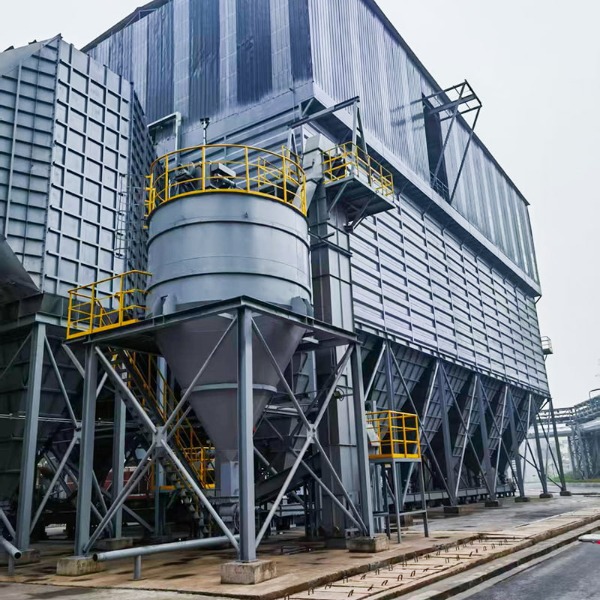
Pulse Jet or Reverse Air: Matching Cleaning Method to Process Conditions
The cleaning method is one of the most consequential choices in a large baghouse. Pulse jet and reverse air designs both remove the dust cake from filter bags, but they suit different operating profiles.
Comparison of common cleaning approaches
| Factor |
Pulse Jet |
Reverse Air |
| Dust loading tolerance |
High, suits heavy dust loads |
Moderate, suits controlled loads |
| Footprint |
Compact, shorter housing |
Larger, multi-compartment layout |
| Cleaning intensity |
Strong, short duration pulses |
Gentle, low-pressure reverse flow |
| Typical application |
Electric furnaces, sintering, lime kilns |
Continuous high-volume kiln exhaust |
Matching method to a real process
In a steel electric furnace exhaust, fume loading can spike sharply during charging and tapping. A pulse jet design handles these surges because each pulse removes the cake quickly, keeping pressure drop stable. A cement kiln exhaust running continuously at high volume with moderate dust content may suit reverse air, which lets individual compartments be taken offline without interrupting flow.
The cleaning method should follow the dust load pattern, not the other way around. Ask whether your process produces steady or spiky dust before choosing.
Housing, Steel Structure, and Large Duct Design
For large installations, structural reliability matters as much as filtration. A housing that deforms under wind, snow, or accumulated ash can crack seams, misalign doors, and let dust bypass the bags.
Design checks that protect long-term operation
Wind and snow loads verified against the local climate zone
Ash load on hopper walls and bracing calculated for worst-case full discharge blockage
Compartmentalized housing so one section can be isolated for maintenance
Abrasion protection at elbows and transition pieces on large-diameter ducts
Field experience
On a lime kiln retrofit where floor space was limited, we stacked two compartment rows at staggered elevations. The steel frame cost more than a standard layout, but it avoided a later shutdown to add capacity. In practice, the extra structural cost is usually recovered within the first major maintenance cycle.
Cleaning System and Filter Bags: Hidden Costs That Shape Lifecycle Spend
Equipment price is only part of the financial picture. Over a five to ten year horizon, cleaning system efficiency and bag life often determine total cost more than the initial quotation.
Where operating costs hide
Pulse valves that leak or open slowly waste compressed air every cycle
Bags that blind early or burn through due to temperature excursions need premature replacement
Poor cleaning control causes excessive cleaning cycles and wears bags faster
Undersized ash conveying causes hopper buildup and forced stoppages
Questions to ask suppliers before signing
| Question |
What a good answer looks like |
| What is the design air-to-cloth ratio? |
A specific value justified by dust type and temperature |
| How is compressed air consumption estimated? |
Based on valve count, pulse duration, and cycle frequency |
| What is the expected bag life under your conditions? |
A range tied to temperature, chemistry, and cleaning settings |
Case Evidence: Problem, Configuration, and Results
Real project data is the clearest way to judge whether a system design will perform. The following summary describes a typical steel plant secondary fume project.
Steel plant secondary fume upgrade
Original problem: The existing collector showed high stack emissions and rising pressure drop, causing frequent fan alarms during peak production.
Configuration: A centralized pulse jet system with a total filter area sized for a design air-to-cloth ratio within the normal range for fine metallurgical dust, with a separate high-temperature zone for the hottest hood.
Results: Outlet dust concentration held below 10 mg/m³, and pressure drop stabilized around 1200 Pa during steady operation.
An installation lesson
During commissioning, one branch duct showed uneven flow because an elbow was placed too close to a fan inlet. Adding a straight run of duct before the fan and smoothing the elbow radius corrected the imbalance. This is a reminder that field verification of duct layout is as important as the drawing.
How to Request a Whole-Plant Layout and Quotation
A useful quotation begins with accurate process data. Without airflow, temperature, dust properties, and site dimensions, any price is only an estimate.
Information to prepare
Total airflow volume and number of capture points
Gas temperature range, including peak and startup conditions
Dust type, particle characteristics, and moisture content
Available site footprint and height limits
Submit these parameters and request a preliminary layout sketch and selection recommendation for your plant. Engineering support can evaluate the duct network, cleaning method, and structural arrangement together.
Frequently Asked Questions
Q1: What filter velocity should be used for a large baghouse?
Filter velocity, or air-to-cloth ratio, depends on dust type, temperature, and cleaning method. Fine metallurgical dust typically requires a lower ratio than coarse material, and the final value should come from process testing and engineering review.
Q2: How long does it take to deliver a whole-plant dust collection system?
Delivery time varies with system size, custom structural requirements, and site readiness. Large projects usually include separate phases for engineering, fabrication, installation, and commissioning, so the schedule should be confirmed against a detailed project plan.
Q3: Why is duct design so important in a centralized system?
Unbalanced ducts cause some hoods to lose capture efficiency while others draw excessive air. Proper sizing and layout keep airflow distributed as designed across all capture points.



 English
 Français
 عربى
 简体中文