English
 Français
 عربى
عربى 简体中文
简体中文


Complete Guide To Coke Drying Wet Dust Removal System For Metallurgical Coking Plant
HOME / NEWS / Industry News / Complete Guide To Coke Drying Wet Dust Removal System For Metallurgical Coking Plant
 By Admin
Content
Coke drying is a critical process in metallurgical and coking plants, but it generates significant operational challenges. The drying furnaces produce high-temperature flue gas laden with fine particulate matter, alongside traces of sulfur compounds and acidic vapor. This complex waste stream presents multiple problems for plant operators.
Traditional dry filtration systems struggle with these conditions. High temperatures risk damaging filter media, while the chemical composition of the exhaust accelerates equipment corrosion. Many facilities face non-compliance with environmental regulations, leading to costly shutdowns and regulatory penalties. Equipment maintenance becomes frequent and expensive, impacting overall production efficiency and profitability.
These challenges demand a more robust solution specifically engineered for high-temperature, high-dust-load industrial environments. This is where wet scrubbing technology becomes essential for modern metallurgical operations.
A coke drying wet scrubber is an integrated environmental control system designed specifically for metallurgical and coking plant applications. The system combines dust collection, temperature reduction, and preliminary sulfur compound removal in a single unified apparatus.
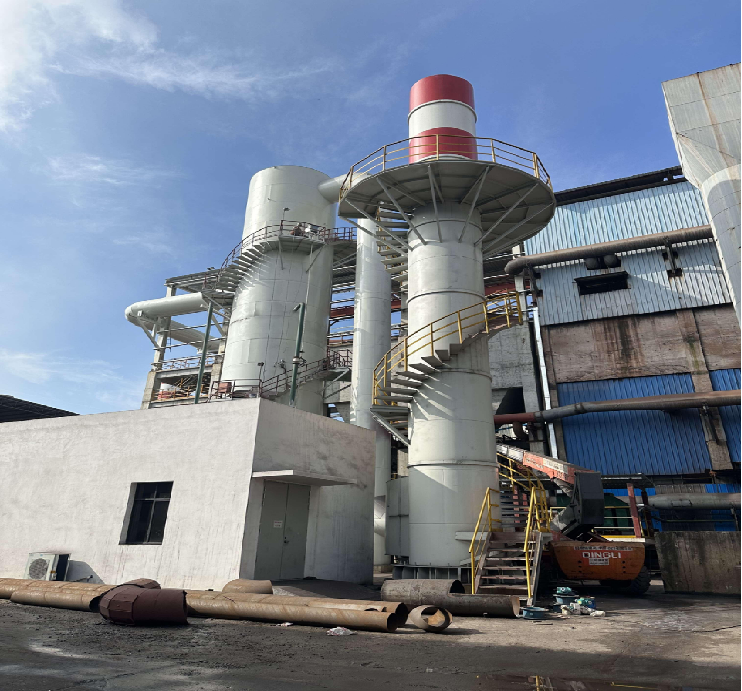
The system consists of a vertical steel tower as the primary contact vessel. The tower features:
Multi-stage internal spray headers for consistent liquid distribution
Spiral inspection stairways with safety platforms for maintenance access
Inlet and outlet piping systems for flue gas routing
Mist elimination chamber to separate entrained water droplets
Top-mounted exhaust stack for clean gas discharge
Integrated circulation water treatment and recovery unit
These components work in concert as a complete one-package solution, requiring minimal on-site assembly and integration with existing production infrastructure.
This technology is specifically suited for:
Coke kiln and drum dryer exhaust treatment
Steel slag drying operations
Metallurgical sintering furnace tail gas management
High-temperature industrial dust collection requiring simultaneous cooling
Understanding how a wet dust collector operates helps explain why this technology is superior for coke drying applications. The process involves several integrated stages that work simultaneously to achieve comprehensive air quality improvement.
Stage 1: Intake and Contact - Hot flue gas from coke drying equipment enters the scrubber tower through the lower inlet connection. The gas velocity is controlled to optimize contact time without creating excessive pressure drop across the system.
Stage 2: Liquid Atomization - Multi-level spray systems distribute wash liquid throughout the tower chamber. The spray pattern creates a dense mist that maximizes surface area contact between liquid droplets and the incoming gas stream.
Stage 3: Particle Capture - Dust particles collide with water droplets and are trapped. Temperature reduction occurs rapidly as high-temperature gas exchanges heat with the cooler scrubbing liquid. The combination of wet capture and evaporative cooling makes this process highly efficient compared to dry methods.
Stage 4: Mist Separation - Treated gas rises through the mist elimination section, where centrifugal forces and impaction remove entrained water droplets. This ensures discharge air meets both environmental and safety requirements.
Stage 5: Exhaust Discharge - Cleaned, cooled gas exits through the top stack at significantly reduced temperature and particulate concentration, meeting regulatory compliance thresholds.
Stage 6: Water Recycling - Dust-laden wash liquid drains to the bottom collection sump, where gravity settling separates solids. Clear water recirculates back to spray headers through dedicated pumping systems, while settled sludge is periodically removed for proper disposal.
Dry bag filters rely on mechanical separation and suffer critical limitations in high-temperature coke drying service. Filter media degrades rapidly above certain temperatures, requiring constant replacement and causing production interruptions. Additionally, dry filters cannot cool gases or remove acidic vapor components.
Wet scrubbing eliminates these constraints. Water provides inherent thermal capacity for cooling, prevents filter media degradation, and chemically neutralizes acidic sulfur compounds. The technology handles temperature extremes that would destroy mechanical filters within days of operation.
Coke drying produces flue gas often exceeding 200 degrees Celsius. This temperature regime destroys mechanical filtration systems within hours. Wet scrubber technology operates reliably across this entire range, cooling gases to safe discharge temperatures while maintaining structural integrity. Equipment investment is protected from thermal degradation damage.
A single unit performs three critical functions simultaneously: particulate collection, exhaust cooling, and preliminary acid gas neutralization. This eliminates the need for separate dust collectors, cooling towers, and chemical treatment systems, reducing capital expenditure and floor space requirements significantly.
Large-diameter vertical tower design withstands aggressive process conditions. Steel construction with optional corrosion-resistant lining accommodates acidic sulfur compounds and high-velocity gas flows. Integrated maintenance platforms and spiral stairways provide safe access for inspection and repair activities, reducing downtime and service costs. The substantial physical structure resists deformation under thermal and pressure cycling stress.
System capacity, internal configuration, and material selection adapt to specific plant requirements. Processing volume ranges from small auxiliary dryers to large primary kiln exhaust systems. Material specifications can incorporate stainless steel, rubber-lined carbon steel, or specialized coatings based on corrosivity assessment and budget parameters. Customers receive engineered solutions rather than generic equipment.
Outlet dust concentrations consistently meet regulatory thresholds without complicated control logic or frequent media changes. The system maintains compliance during varying production rates and fuel quality fluctuations, eliminating penalty risks and operational uncertainty.
| Criteria | Wet Scrubber | Dry Bag Filter |
|---|---|---|
| Temperature Tolerance | Up to 260 C | Up to 130 C |
| Media Replacement Frequency | Minimal (none) | Every 12-24 months |
| Acid Gas Removal | Yes (with additives) | No |
| Integrated Cooling | Yes | No |
| Operational Reliability | High (90%+ uptime) | Moderate (70-80%) |
| Water Consumption | Moderate (recycled) | None |
| Annual Operating Cost | Lower (5-7K) | Higher (15-20K) |
This comparison demonstrates that wet scrubbing technology provides superior performance for metallurgical applications where high-temperature, high-dust-load conditions are standard operating parameters.
Proper equipment selection requires comprehensive assessment of your specific operating conditions. Engineers need the following data to develop accurate proposals and ensure satisfactory performance:
Volumetric flow rate of exhaust gas (measured in cubic meters per hour or CFM)
Inlet gas temperature range and expected fluctuations
Dust concentration at inlet (grams per cubic meter or grains per cubic foot)
Dust particle size distribution and composition analysis
Presence and concentration of chemical compounds (sulfur oxide, hydrogen sulfide)
Available installation footprint and height clearance
Water quality characteristics and availability at the facility
Environmental discharge standards applicable to your jurisdiction
Production schedule and required system availability percentage
Modern suppliers provide comprehensive, integrated solutions that eliminate complexity from your procurement process. Beyond the main scrubber vessel, complete systems include:
Engineered inlet and outlet ducting with proper expansion joints
Centrifugal circulation pumps rated for continuous industrial duty
Automated spray header nozzles for uniform liquid distribution
Sludge collection and handling equipment
Electrical control systems with temperature and pressure monitoring
Structural support frameworks engineered for your site conditions
Complete technical documentation and operational manuals
Commissioning support and staff training
This packaged approach simplifies procurement, installation, and ongoing management compared to assembling components from multiple vendors.
Successful deployment depends on proper planning and execution during the installation phase. The location must provide adequate foundation capacity for the filled tower weight, typically ranging from 5 to 15 tons depending on vessel size. Proper drainage for sludge disposal and water discharge is essential. Utility connections for electrical power and water supply must be confirmed before equipment arrival.
Vertical alignment of the tower structure is critical for balanced internal flow distribution and optimal performance. Professional installation teams use precision instruments to verify plumb alignment within industry standards. Properly sealed ductwork connections prevent air bypassing and maintain collection efficiency.
Once operational, systems require minimal hands-on management. Operators should monitor inlet temperature, maintaining parameters within design specifications. Pressure gauges track system resistance, providing early warning of potential blockages or operational issues. Water level in the collection sump requires periodic visual confirmation. Basic visual inspection for leaks or unusual noise patterns helps identify maintenance needs early.
Monthly: Clean spray nozzles to prevent mineral buildup that reduces atomization efficiency. Inspect pump bearings and seals for any indication of wear.
Quarterly: Sludge removal from collection basin. Sample and analyze recycled water for pH balance and corrosion inhibitor concentration. Inspect accessible internal surfaces for scale accumulation.
Annual: Professional inspection of internal tower surfaces by qualified technicians. Pump seal replacement if wear is evident. Complete water treatment system analysis and possible replacement of chemical additives.
This preventive maintenance schedule typically costs one-fifth of the expense associated with emergency repairs and unplanned shutdowns.
Coke drying operations present complex air quality challenges beyond simple dust collection. The high-temperature exhaust carries volatile organic compounds, sulfur dioxide, and fine particulate matter that threaten environmental compliance. A properly designed and operated wet scrubber addresses all three simultaneously.
Particulate matter reduction typically exceeds 95 percent when designed for specific inlet dust concentrations. Temperature reduction from inlet to outlet reaches 80-100 degrees Celsius, which benefits downstream equipment and reduces thermal impact on local air quality. Sulfur compound removal efficiency ranges from 60-80 percent through dissolution in recycled water, with enhanced performance achievable through alkaline additive dosing.
Modern flue gas washing tower technology incorporates water recycling to minimize environmental footprint and operational cost. Collected sludge settles in the basin for periodic removal, concentrating waste into a manageable volume. Many facilities successfully send this material to appropriate industrial waste processors rather than landfill, supporting circular economy principles.
The water discharge quality improves continuously through the recycling process as sediment settles and suspended solids decrease. Final water discharge, if required, typically requires only basic pH adjustment before environmental release.
Environmental agencies worldwide establish specific discharge limits for dust, temperature, and chemical compounds from industrial processes. Wet scrubbing technology consistently meets or exceeds these requirements, typically operating with 30-40 percent margin below regulatory thresholds. This provides operational buffer for production rate variations and fuel quality changes that would otherwise cause compliance violations.
A complete integrated wet scrubber system for typical medium-sized coking operations requires capital investment in the range commonly justified by environmental compliance requirements and production protection value. While initial system cost exceeds simple dry collection alternatives, the total cost of ownership significantly favors wet scrubbing when analyzed over 10-year operating periods.
Key cost factors include:
Vessel construction and internal components: 40-45 percent of total
Pumping, piping, and auxiliary equipment: 25-30 percent
Controls, instrumentation, and electrical: 15-20 percent
Installation, testing, and commissioning: 10-15 percent
Dry filter systems accumulate significant ongoing expenses through filter replacement, which occurs multiple times annually in high-temperature applications. Wet scrubbers eliminate this recurring expense almost entirely. Water consumption costs are offset through recycling systems that recover and reuse 80-90 percent of circulated volume. Electricity consumption for pump operation is modest compared to compressed air requirements for dry filter pulse cleaning.
Annual operating cost advantage of wet scrubbing typically reaches 10,000 to 15,000 currency units compared to equivalent dry filtration systems over a five-year period. This savings alone justifies system selection based purely on economic analysis, before considering reliability and environmental compliance benefits.
Environmental violations carry penalties ranging from moderate fines to facility closure orders, depending on jurisdiction severity. Production interruptions from equipment failure cost substantially more than routine system maintenance. Insurance premiums reflect operational reliability and environmental compliance history. Wet scrubber systems reduce all three risk categories simultaneously, providing financial protection beyond direct operating cost savings.
Water consumption depends on system size and inlet gas temperature, typically ranging from 100 to 500 liters per hour of operation. However, integrated recycling systems return 80-90 percent of this volume for reuse, significantly reducing net consumption. Most facilities discover that makeup water requirements are surprisingly modest, often less than 10-20 liters per hour after accounting for recycling efficiency and evaporative losses.
Operating without active spray circulation would quickly lead to system damage from high-temperature gas contact with dry internal surfaces. Modern systems include automatic shutdown interlocks that cease production feed if water pressure drops below minimum levels. This protection prevents catastrophic damage and allows operators time to address supply issues before restarting production.
Sludge accumulation rates depend on inlet dust concentration and system size. Typical facilities remove settled material monthly, though some high-dust-load applications require weekly removal. Modern collection basins incorporate sloped bottoms and drain ports that facilitate complete emptying without manual entry into confined spaces. Most facilities contract with industrial waste specialists for periodic collection and proper disposal.
Water alone provides limited sulfur compound removal capability, typically 30-40 percent efficiency through simple dissolution. Enhanced performance requiring 70-80 percent removal efficiency necessitates alkaline additive dosing to chemically neutralize acidic gases. Sodium hydroxide or alkaline slurry addition is standard practice in professional systems. Dosing equipment operates automatically based on outlet gas analysis, minimizing chemical consumption while maintaining target performance.
Wet scrubber systems are significantly less complex than equivalent dry filtration setups. Training typically requires 1-2 days of hands-on instruction covering pump operation, nozzle cleaning, sludge removal procedures, and basic troubleshooting. Most operators quickly become proficient with routine maintenance tasks. Professional technician support from suppliers is available for more complex annual inspections or component replacement.
Oversized dust loads reduce collection efficiency moderately and accelerate sludge accumulation, requiring more frequent basin cleaning. Modern designs incorporate capacity margin to handle typical operational variations without significant performance loss. However, sustained operation above design specifications will eventually require system upsizing or additional collection stages to maintain compliance. Regular monitoring through outlet dust measurement provides early warning if adjustments become necessary.
Wet scrubber systems operate relatively quietly compared to dry collectors with loud pulse-cleaning events. Circulating pump operation and gas flow through the tower generate sound levels typically below 85 decibels at distance, meeting most industrial facility standards. Additional sound attenuation materials can be incorporated if specific noise constraints exist at the installation site.
Well-maintained systems typically operate successfully for 15-20 years before major component replacement becomes necessary. The robust steel construction resists operational wear when preventive maintenance is followed consistently. Spray headers, pump seals, and non-ferrous internal components may require replacement at 7-10 year intervals depending on water quality and chemical composition of the processed gas. This extended service life significantly improves long-term economic performance compared to alternatives requiring frequent replacement.