English
 Français
 عربى
 简体中文


What Copper Smelter Off-Gas Systems Need: Matching Dust Collection with Desulfurization
HOME / NEWS / Industry News / What Copper Smelter Off-Gas Systems Need: Matching Dust Collection with Desulfurization
 By Admin
Content
Copper smelters rarely run into trouble because of one failed machine. The more common problem is a mismatch between systems. A dust collector is selected on purchase price, a scrubber is selected on chemistry alone, and the control logic was never designed to run them as one process. The off-gas leaving a smelter carries fine metal-bearing dust, acidic gases, and temperature swings that change by the hour. When these streams are treated as separate problems, the result is often premature filter failure, corroded ductwork, and emission results that look acceptable at commissioning but drift out of compliance within a few years.
This guide is written for plant engineers and buyers who need decisions that will hold up over a decade of operation. It walks through gas characteristics, filter technology, desulfurization routes, filter media, compliance checkpoints, and lifetime cost. Along the way it explains why the boundary between dust removal and gas scrubbing matters so much, and it closes with the questions that come up most often on real projects.
Before comparing hardware, it helps to understand what the equipment has to survive. Off-gas from copper smelting is hot, dusty, and chemically aggressive, and each property pushes the design in a specific direction. A sound dust collection system starts from measured gas data rather than generic assumptions, because two smelters with the same nameplate capacity can produce very different gas streams depending on their feed mix and furnace practice.
Temperature and acid dew point are the first constraints engineers check. Sulfur trioxide in the gas can condense as sulfuric acid when surfaces cool below the dew point. That condensate attacks carbon steel, coats filter bags, and turns loose dust into a paste that blinds fabric. Designers usually keep the operating temperature a comfortable margin above the acid dew point, commonly 10 to 25 degrees Celsius, using insulation, heat tracing, or a controlled gas cooler so that cooling happens deliberately rather than by accident inside the ductwork.
Particle size is the second driver. Dust generated in smelting furnaces is extremely fine, with many particles falling between 0.03 and 0.3 micrometers. These particles are rich in metals such as arsenic, lead, and cadmium, and their emission is tightly regulated. Fine dust with high electrical resistivity is also difficult to capture in electrostatic precipitators, which is one reason filtration has become the preferred route for metal-bearing streams.
The third driver is variability. Batch operations, such as converter blowing, create sharp swings in sulfur dioxide concentration. Peaks can reach roughly three times the daily average, and they often coincide with bursts of dust. A system sized only for average conditions will either underperform during peaks or rely on oversized equipment that runs at low efficiency for most of the day. Both outcomes raise lifetime cost.
| Parameter | Typical Behavior | Design Implication |
|---|---|---|
| Gas temperature | Varies widely by process stage | Sets cooling, insulation, and heat tracing needs |
| Particle size | 0.03 to 0.3 micrometers | Favors fabric filtration over precipitation |
| Sulfur dioxide peaks | Up to three times the daily average | Requires scrubber surge capacity |
| Acid dew point risk | High when sulfur trioxide is present | Requires temperature margin and corrosion-resistant materials |
| Metal content | Arsenic, lead, and cadmium are common | Requires high capture efficiency and sealed handling |
Moisture deserves its own check. Water vapor in the gas lowers the effective dew point of the acid mixture under some conditions and can cause sticky cake formation even when temperature appears adequate on paper. For this reason, the most useful site survey data includes humidity readings taken across several operating cycles, not a single spot measurement.
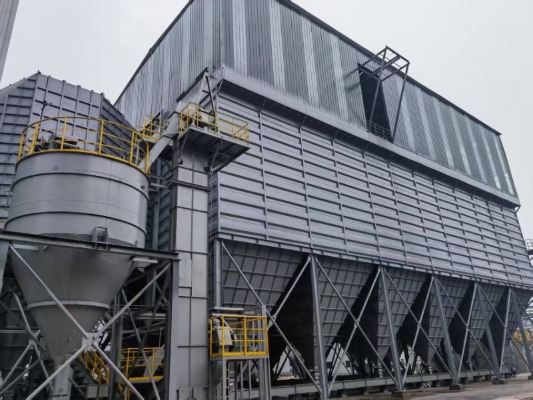
Electrostatic precipitators have a long history in non-ferrous metallurgy, and many still operate in plants today. Their performance, however, depends heavily on particle resistivity, gas composition, and the condition of the electrical fields. Industry reviews of base metal smelting have noted that many older precipitators achieve efficiencies in the 80 to 90 percent range, which can fall short of the tighter limits that current best available technique guidance expects.
Fabric filters, usually called baghouses, capture particles mechanically as gas passes through woven or felted media. Well-maintained units can keep dust emissions in the range of about 1 to 5 milligrams per normal cubic meter. Because heavy metals travel with the particles, stack dust concentration largely determines metal discharge. A high-efficiency filter therefore reduces metal emissions directly, not as a secondary benefit.
Selection rarely turns on a single parameter. The situations below cover most of the decisions engineers face during design reviews.
Plants that need a tailored answer usually benefit from custom baghouse systems designed around measured gas data, with the filter house layout, cleaning method, and inlet arrangement matched to the specific dust. A generic catalog layout rarely accounts for the combination of fine metal dust and acid conditions that smelter streams present.
The figure below shows a typical sequence in which dust removal and desulfurization work as connected stages rather than independent units.
Dust removal and flue gas desulfurization are interdependent. Dust that reaches a wet scrubber can coat spray nozzles, create sludge that is hard to dewater, and reduce absorbent efficiency over time. For that reason, the dust removal stage is effectively the first line of defense for any desulfurization process. The design of the interface, including ductwork, temperature control, and reagent injection points, often matters more than the individual specifications of either unit.
| Process | Suitable Gas Level | By-Product | Interface Requirement |
|---|---|---|---|
| Dry lime injection with fabric filter | Lower concentrations | Calcium sulfite and sulfate solids | Reagent injected upstream of the filter bags |
| Wet alkaline scrubbing | Medium to high | Gypsum and wastewater | Gas cooled and dedusted before the tower |
| Contact sulfuric acid plant | High, concentrated streams | Sulfuric acid | Requires dust removal, cooling, and mist elimination |
Converter blowing produces short bursts of high sulfur dioxide that a steady-state system may not absorb. Feedforward control, in which analyzers measuring inlet gas adjust reagent dosing before the outlet concentration changes, performs better than feedback control alone. Larger recirculation tanks in wet systems and spare injection capacity in dry systems provide additional margin. Operators should also expect peak conditions to test the dust removal stage, because the upstream process often becomes dustier during the same events.
Wet alkaline systems deserve particular care with water balance. Scrubbing adds moisture to the gas, and blowdown must be treated before discharge. Dry systems avoid wastewater but require reagent handling, solid by-product disposal, and filter bags that can tolerate the chemical load. Neither route is universally better. The right choice depends on water availability, by-product markets, and the gas concentration profile.
Gas temperature at the scrubber inlet and the margin above the acid dew point.
Dust loading after the filter, with alarms that trigger before scrubber fouling begins.
Reagent dosing response time during converter peaks.
Mist elimination and drainage design for wet systems.
Filter bags are the consumable that most directly connects design decisions to operating cost. Media choice depends on temperature, chemical exposure, abrasion, and the cleaning method used. No single material is best everywhere, and a premium fabric applied to the wrong gas stream can fail as quickly as an inexpensive one.
| Media | Upper Temperature Limit | Acid Resistance | Typical Use | Watch Points |
|---|---|---|---|---|
| PPS | 190 degrees Celsius | Moderate | Standard smelter off-gas | Hydrolysis risk with high sulfur trioxide |
| PTFE membrane | 260 degrees Celsius | Excellent | High arsenic, high acid, very low emission targets | Higher upfront cost, offset by longer life |
| Glass fiber | 280 degrees Celsius | Moderate | High-temperature gas streams | Poor abrasion resistance and flex sensitivity |
Media selection works best as a system decision. If gas can be brought into the optimal temperature window with an upstream heat exchanger, the filter can often be specified more economically and will usually last longer. A membrane fabric cannot compensate for gas that repeatedly drops below the acid dew point, while a basic fabric can perform well when process conditions are stable and well controlled.
Bag life depends as much on cleaning practice as on fiber selection. Many designs use compressed air at pressures around 0.5 to 0.6 megapascals, but the right setting depends on dust cohesion and bag geometry. Pulses that are too frequent accelerate flex fatigue, while pulses that are too infrequent allow a dense filter cake to build and drive up pressure drop. Good practice is to tune pulse timing against measured differential pressure rather than against a fixed clock.
Replacement planning should also account for how bags fail. Abrasion usually appears near the tube sheet and at seams, chemical attack tends to show up as stiffening or discoloration, and blinding appears as a steady rise in pressure drop that cleaning cannot reverse. Recording these patterns during inspections helps the plant decide whether the next replacement should change media, cleaning settings, or temperature control.
Spare bag inventory is a practical detail that often gets overlooked. Keeping a small stock of the specified media, with documented installation procedures, shortens recovery time after a failure and prevents emergency purchases of substitute fabrics that may not match the original performance.
Compliance targets vary by jurisdiction, permit conditions, and whether a plant is new or being upgraded. Best available technique documents provide useful reference ranges for planning, but the binding figures are always those in the local environmental approval. The table below summarizes typical reference values that engineers commonly use during feasibility work.
| Pollutant | Reference Range | Typical Basis |
|---|---|---|
| Dust | 1 to 5 milligrams per normal cubic meter | Fabric filtration with good maintenance |
| Sulfur dioxide, dry treatment | Below 500 milligrams per normal cubic meter | Lime injection with fabric filtration |
| Sulfur dioxide, wet treatment | 50 to 200 milligrams per normal cubic meter | Alkaline scrubbing |
| Heavy metals | Tracks dust concentration | Controlled through particle capture |
All values should be confirmed against the local approval before design begins. Equipment sized for the wrong target can require expensive modification after commissioning.
Use the following checklist to compare proposals on substance rather than headline price.
Does the proposal verify gas parameters with measured data rather than assumed values?
Is filter media selected based on an analysis of metal content and acid dew point?
Does the scrubber design account for sulfur dioxide peaks during batch operations?
Are the interface points between dust removal and desulfurization shown in a process and instrumentation diagram?
Can the supplier present references from comparable non-ferrous smelting projects of similar scale?
A compliance check at the design stage costs far less than retrofitting after commissioning, and it gives the plant a documented basis for every equipment decision that follows.
Equipment price is only one part of what a plant pays. Over five to ten years, energy, filter replacement, and downtime often exceed the original capital cost. A lower bid frequently reflects thinner housings, lighter media, or simplified cleaning controls. Those savings tend to surface as rising pressure drop, higher fan power, and unplanned shutdowns within a few years of startup.
These ranges are indicative and will shift with energy prices, labor costs, and plant utilization. They are useful mainly because they show where optimization effort pays off. The chart below compares midpoint values to illustrate how the cost categories relate to one another.
Pressure drop deserves particular attention because it converts directly into electricity. A design that keeps differential pressure low through an appropriate air-to-cloth ratio, sound cleaning control, and correctly selected fans can reduce long-term energy consumption substantially. Variable frequency drives on fans allow the system to respond to actual flow instead of running at full power at all times.
Redundancy is another lever. Compartmented baghouses and bypass arrangements let maintenance proceed on one section while the rest of the plant keeps operating. The value of this is easiest to see when a single unplanned shutdown costs more than the price difference between two competing proposals.
Consider a mid-sized secondary copper facility that replaced an aging precipitator with a fabric filter. The lowest proposal used lighter media and a simpler cleaning control. During the first two years, pressure drop climbed steadily, fan power rose, and the plant lost several production shifts to bag failures and cleaning faults. A second evaluation favored higher-grade media, controlled inlet temperature, and compartmentation. Although its purchase price was higher, the projected energy and downtime savings recovered the difference within a few years of operation.
The right off-gas treatment system is not the one with the lowest bid. It is the one that still meets its emission limits in year five, with stable energy use and predictable maintenance.
For most smelter off-gas streams, especially those carrying fine metal-bearing dust, a high-efficiency fabric filter is the preferred choice because it can keep particulate emissions in the low milligram range. Precipitators can still work in specific cases, but their performance on fine, resistive dust is harder to guarantee. Media selection and acid dew point control determine how well the baghouse performs over time.
Peaks are best managed with feedforward control driven by inlet gas analyzers, combined with a reagent system that can increase dosing quickly. Larger recirculation tanks in wet systems and spare injection capacity in dry systems add operational buffer. A stable upstream dust removal stage also protects the scrubber from fouling during these events.
Fine, sticky dust forms a dense cake on the filter surface. Common causes include insufficient cleaning pressure, pulse intervals that are too long or too short, and gas temperatures that approach the acid dew point, which leads to moisture-related blinding. Reviewing these three factors usually identifies the cause quickly.
Membrane-laminated fabrics suit high arsenic or high acid conditions, while standard PPS can handle many routine streams. The most important step is keeping gas temperature within the chosen media's safe window, often through an upstream heat exchanger or insulation, rather than simply buying a more expensive fabric.
Reference values from best available technique guidance give useful planning ranges, such as roughly 1 to 5 milligrams per normal cubic meter for dust. The binding limits are those in the local environmental approval, which may also include tighter regional requirements. Confirming them at the start of design ensures that equipment is sized for the correct target.