English
 Français
 عربى
 简体中文


Industrial Baghouse System for High Dust Load: Practical Applications, Selection
HOME / NEWS / Industry News / Industrial Baghouse System for High Dust Load: Practical Applications, Selection
 By Admin
Content
A cement plant that adds a raw mill can push baghouse inlet loading from 4 g/Nm3 to 12 g/Nm3 without touching the fan or the housing. Within weeks the unit that held 1,200 Pa runs at 2,000 Pa, pulse valves fire continuously, and bags fail at the tube sheet instead of the cage. An industrial baghouse system for high dust load is not a standard unit with more bags bolted on; the cleaning method, the air-to-cloth ratio, the inlet transition and the ash removal chain all move together.
High dust load is a mass problem rather than a concentration reading. The number that drives your design is grams of particulate per normal cubic metre arriving at the inlet plenum, multiplied by the gas volume you cannot reduce.
Dust load, also called grain loading, is the mass of particulate entering the baghouse divided by the gas volume at standard conditions, written as g/Nm3. A unit designed for 3 g/Nm3 that is fed 12 g/Nm3 carries four times the ash per hour and builds filter cake roughly four times faster.
Two consequences follow. The cleaning cycle shortens, so a bag that pulsed every 40 minutes now pulses every 6 to 8 minutes, and each pulse drives dust deeper into the felt. The hopper and ash chain also become the bottleneck: a rotary valve sized for 1.5 t/h of dust has to move 4 t/h, or the hopper backs up, the inlet fills, and re-entrainment begins.
Pressure drop that climbs again within 24 hours of a cleaning cycle, which points to cake that cannot release.
Dust found on the clean-air side at the tube sheet rather than at the bag body, a sign of high can velocity rather than fabric failure.
Ash still flowing from the hopper after the fan stops, which means the discharge chain is undersized for the real load.
Above roughly 10 g/Nm3 at the inlet, select the cleaning method before you calculate cloth area. The method fixes the air-to-cloth ratio, and the ratio fixes how much cloth, housing and compressed air the project will carry.
| Cleaning method | Air-to-cloth ratio | Inlet dust load | Behaviour under heavy loading |
| Mechanical vibration | 2:1 to 3:1 | Below 3 g/Nm3 | Offline cleaning only; cake releases unevenly and bags wear at the clamp |
| Negative-pressure reverse air | 3:1 to 4.5:1 | 3 to 6 g/Nm3 | Gentle on sticky dust, but very little cloth area per compartment |
| Low-pressure pulse jet | 5:1 to 7:1 | 6 to 15 g/Nm3 | Best balance for heavy fume; depends on dry air at 0.4 to 0.6 MPa |
| Rotary jet | 8:1 to 12:1 | 5 to 10 g/Nm3 | Compact housing, but the long pulse path punishes bag length tolerance |
Low-pressure pulse jet wins most high-load projects, provided the compressed air is dry and the pulse sequence is triggered by differential pressure instead of a fixed timer. Pulsing on a timer in a 12 g/Nm3 stream over-cleans the first rows and starves the last ones, which is why two compartments of the same collector can show completely different bag life.
 Low-Pressure Pulse Jet Bag Dust CollectorFor high-load flue gas, this customizable baghouse uses pulse-jet cleaning and selectable bag and body materials to suit temperature and dust.View Product →
The cheapest place to cut dust load is at the furnace, not at the baghouse. Capture hoods reduce the mass that reaches the filters, so the same housing keeps a workable air-to-cloth ratio instead of drifting into permanent overload.
A blast furnace taphole capture hood with the correct extraction volume holds 90 to 95 percent of the tapping fume, and hoods at the vessel mouth do the same during blowing. Both cut inlet loading by roughly three to five times during the peak minutes that otherwise set the whole design point.
Inlet loading swings from 3 to 15 g/Nm3 within one heat. Cloth area is sized for the spike, so the plant pays for capacity it uses a few minutes per hour, and bag life settles at 12 to 18 months.
Inlet loading holds at 2 to 4 g/Nm3 through the cycle. The same collector runs at a lower filtration velocity, pressure drop stays near 1,000 Pa, and bag life moves toward 3 years.
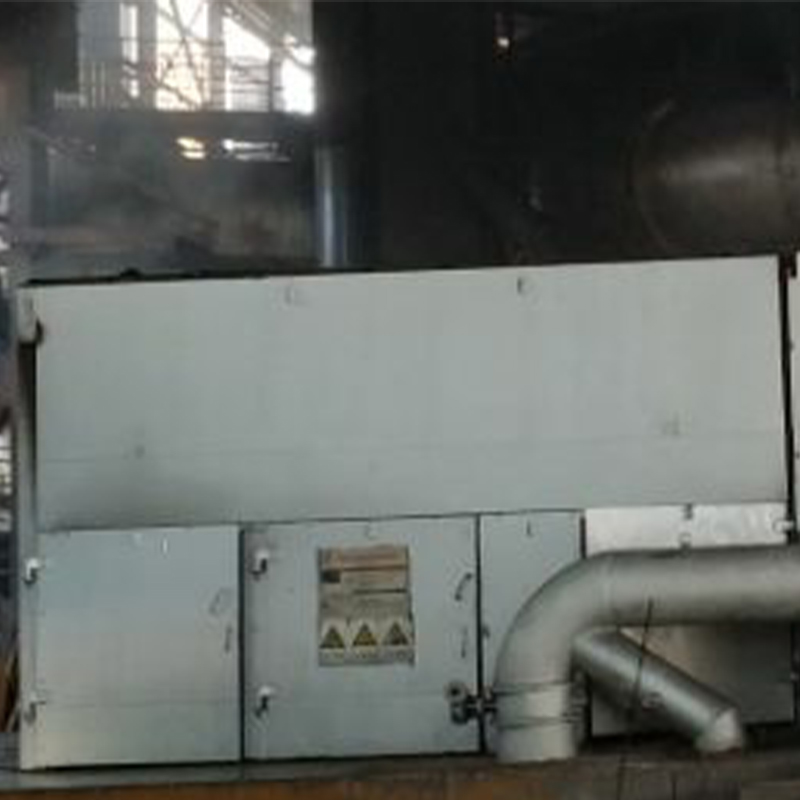 Blast Furnace Taphole Capture HoodFully enclosed taphole hood captures tapping smoke and temporarily stores blowout fumes; movable top door supports inspection and maintenance.View Product →
Hood design details matter as much as hood presence: converter front capture hoods only hold their capture rate when the skirt gap and extraction volume are tuned to the vessel, and a hood that is 20 percent undersized behaves like no hood at all during the peak.
In high dust load service, the failures that stop a unit are almost always in the hopper and in the bag hardware, not in the fabric itself. Fabric is selected last, after the mass balance is settled.
Hopper slope of 60 degrees minimum, and 70 degrees for dust that is even slightly cohesive; a 55 degree hopper bridges at 4 t/h of ash.
Discharge equipment sized on peak ash rate, not average: screw conveyor, rotary valve and chute all in the same calculation.
An inlet baffle or wear plate in front of the first bag row, so the incoming jet loses velocity before it touches cloth.
Can velocity below about 1 m/s at the hopper inlet, which prevents settled dust from being picked up again.
| Media | Continuous temperature | Abrasion resistance | Where it fits |
| Polyester felt with PTFE membrane | 130 deg C | Good | Default for dry fume below the limit; membrane keeps cake release clean |
| Aramid needle felt | 190 deg C | Very good | Steel and foundry fume with occasional sparks; needs proper pre-coating |
| PPS needle felt | 170 deg C | Good | Boiler and coal flue gas; avoid oxidizing spikes above 190 deg C |
| Fibreglass woven | 260 deg C | Fair | Kiln and cement gas; abrasion shortens life quickly if can velocity is high |
| PTFE felt | 240 deg C | Good | High moisture or chemically aggressive duty; highest cost per square metre |
Cage and bag hardware are the second weak point. A two-piece cage, a vented top cap and a proper snap band cost little compared with a shutdown, and keeping a matched spare set of
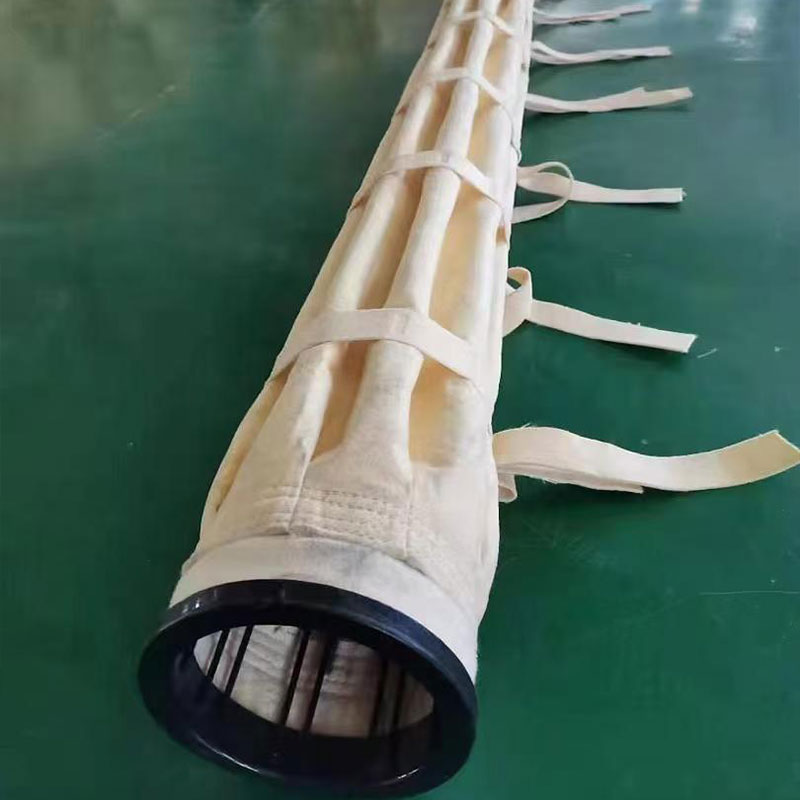 Custom Woven and Non-Woven Dust Filter BagsMatched spare filter bags in woven or non-woven materials, chosen by particle size, temperature and chemical resistance for dust collection.View Product →
on site shortens the replacement window from days to hours.
Commissioning numbers decide whether the design survives contact with the process. Record them before the unit is handed over, because every later argument about performance starts from this baseline.
Log differential pressure across each compartment at zero load, then at full load, and record fan amps. A spread of more than 200 Pa between compartments points to a damper or duct problem.
Feed a controlled dust load for 30 to 60 minutes before raising gas volume, so the first cake forms evenly and the membrane is protected from embedded particles.
Set the pulse trigger to differential pressure, then verify compressed air header pressure stays above 0.4 MPa during the peak sequence, not just at idle.
Sampling during peak furnace operation catches leaking bags that read clean at steady state; anything above 10 mg/Nm3 on a new installation means a fit or installation fault.
Compare ash discharge rate with the mass balance, and inspect the first bag row for abrasion. This is the point where air-to-cloth ratio errors become visible.
Above roughly 15 to 20 g/Nm3, a mechanical pre-collector usually pays for itself within two bag replacement cycles. Below that, correct air-to-cloth ratio and offline cleaning handle the load more cheaply than adding equipment.
Sometimes, but only if the additional load is matched by lower filtration velocity. That means reducing gas volume, adding a compartment or running offline cleaning; if neither is possible, the hopper and inlet will become the new failure point.
For low-pressure pulse jet service, specify 0.8 to 1.0 m/min filtration velocity, which corresponds to about 5:1 or 6:1. Mechanical shaker units need 2:1 or lower, and rotary jet units should not be pushed above 10:1 when the inlet exceeds 8 g/Nm3.
Two to three years when the inlet is controlled and pressure drop stays near 1,000 Pa. Overloaded units often show first failures at 12 to 18 months, and those failures typically appear in the first rows near the inlet rather than uniformly across compartments.