English
 Français
 عربى
عربى 简体中文
简体中文


What Makes a Custom Pulse Jet Pleated Cartridge Filter Worth the Investment?
HOME / NEWS / Industry News / What Makes a Custom Pulse Jet Pleated Cartridge Filter Worth the Investment?
 By Admin
Content
Most industrial dust collectors were not designed around a single universal filter. They were built to a specification: a specific airflow, a specific particulate load, a specific temperature range, and a specific physical envelope. When a maintenance team replaces the original filter with a generic cartridge, they introduce a mismatch that may not appear immediately but will surface as rising differential pressure, shortened service life, and unpredictable compressed air consumption.
The search for a pulse Jet pleated cartridge filter custom usually begins with a problem, not a product desire. A plant engineer notices that filter bags are failing every few months. A procurement officer sees compressed air costs climbing. A maintenance supervisor struggles to fit a standard cartridge into a housing that was fabricated decades ago. These are the real triggers behind a custom filter inquiry.
This article examines the engineering and economic logic behind custom pleated cartridges for pulse jet systems. It is written for the people who specify, purchase, and maintain dust collection equipment, and it focuses on practical decision criteria rather than generic product claims.
Pulse jet cleaning is a demanding operating mode. A short burst of compressed air is directed into the clean side of the filter, causing the pleats to flex and releasing the dust cake that has accumulated on the dirty side. This cycle repeats hundreds of times per day. The filter media must therefore withstand repeated mechanical stress while maintaining its filtration efficiency.
A pleated cartridge geometry is particularly well suited to this environment because it packs a large surface area into a compact footprint. The pleats create channels that distribute the pulse energy more evenly than a flat bag, and the rigid construction eliminates the need for a internal cage. Removing the cage removes a common failure point: the abrasion that occurs where bag fabric rubs against metal support structures.
Pleated media offers four to six times the filtration area of a standard bag in the same housing volume.
No cage means no bottom wear and no cage corrosion contributing to premature failure.
Pulse energy is distributed across a self-supporting pleat pack rather than a flexible fabric tube.
Cartridge end caps and flanges can be machined to match existing tube sheets without modification to the housing.
Dust collector housings are rarely interchangeable. A unit installed in a cement plant in 1998 may have a tube sheet with a bolt circle that no longer matches any current catalog offering. A pharmaceutical facility may require a cartridge that fits a stainless steel housing with a specific sanitary finish. A metalworking shop may need a short, wide cartridge to fit a low-profile collector that was custom fabricated on site.
When a standard cartridge is forced into a non-standard housing, several things happen. The seal may not seat properly, allowing dust to bypass the filter. The cartridge may not engage the pulse jet venturi correctly, reducing cleaning efficiency. The available filtration area may be less than the system requires, causing the fan to work harder and the pressure drop to rise.
| Dimension | Typical Range | Impact of Mismatch |
|---|---|---|
| Outer diameter | 125 mm to 350 mm | Poor seal, bypass, or physical interference |
| Inner diameter | 60 mm to 200 mm | Venturi misalignment, uneven pulse distribution |
| Height | 660 mm to 3000 mm | Reduced filtration area, increased air velocity |
| Flange bolt pattern | Custom | Installation impossible without adapter |
| End cap configuration | Open, closed, threaded | Leakage path or structural failure |
The media is the heart of any filter cartridge. A cartridge that performs well in a cement kiln may fail quickly in a chemical dryer. The difference lies in the fiber chemistry, the surface treatment, and the way the media is pleated and finished.
| Media | Continuous Temperature | Peak Temperature | Best For |
|---|---|---|---|
| Polyester | 130 C | 150 C | General dust, moderate abrasion |
| PPS (Polyphenylene Sulfide) | 176 C | 200 C | Acid resistance, coal fired boilers |
| Aramid | 200 C | 240 C | High temperature, metal processing |
| PTFE Membrane | Depends on backing | Depends on backing | Sticky dust, fine particulate |
| Nanofiber | Depends on backing | Depends on backing | Sub-micron capture, food and pharma |
Media selection also involves the finish. Singed, calendered, or PTFE coated surfaces change how dust releases from the pleats. In applications where dust is oily or hygroscopic, a membrane may be essential. In abrasive applications, a heavier weight media or a protective scrim may be required.
Differential pressure, often abbreviated as DP, is the single most useful indicator of filter performance and energy cost. Every unit of DP represents resistance that the fan must overcome. In a typical pulse jet dust collector, the fan accounts for the majority of electrical consumption. Reducing DP by even a small margin can produce measurable savings over a year of continuous operation.
Custom pleating affects DP in several ways. The pleat depth, pleat spacing, and media permeability determine how easily air passes through the cartridge. A cartridge with too few pleats has high face velocity and high DP. A cartridge with too many pleats may pack dust too tightly, causing bridging and incomplete cleaning.
Field data from replacement projects consistently shows that a properly specified custom pleated cartridge can reduce operating DP by thirty to fifty percent compared to worn bags or mismatched cartridges. The exact figure depends on the dust loading, the cleaning cycle, and the media selected.
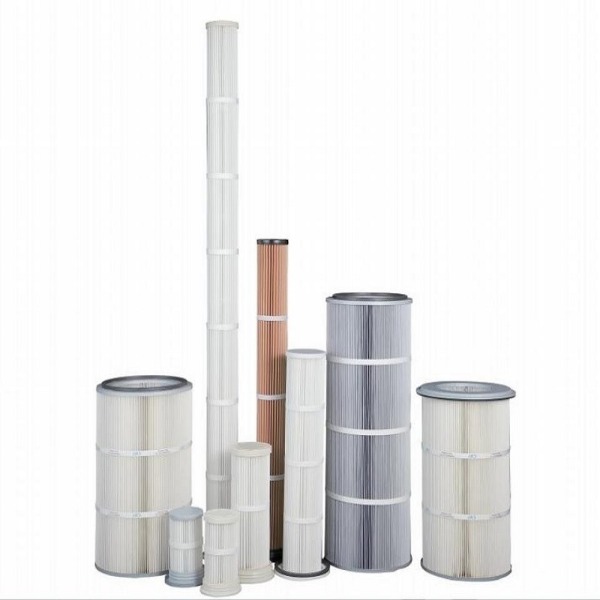
Different industries present different challenges. A cartridge that works well in one may fail in another. The following sections describe common applications and the custom features that matter most.
Cement dust is abrasive and alkaline. It tends to pack tightly and resist release during pulse cleaning. A custom cartridge for this environment typically uses a heavier polyester media with a singed surface, deeper pleats to reduce face velocity, and a robust end cap design that resists abrasion from the dust inlet.
Chemical processes often produce acidic or corrosive particulate. PPS media is a common choice because it resists hydrolysis and acid attack better than polyester. In waste incineration, trace amounts of hydrogen chloride and sulfur oxides can degrade filter media quickly. A custom cartridge with PPS media and a protective membrane can extend service life significantly.
In these industries, filtration efficiency and cleanability are paramount. Nanofiber media captures sub-micron particles that standard media may pass. The cartridge construction must also avoid crevices where bacteria could harbor. Custom end caps with smooth transitions and sanitary finishes are often required.
Welding fume is fine, sticky, and often contains metal oxides. Standard cartridges may blind quickly. A custom cartridge with a PTFE membrane and a pleat geometry optimized for pulse release can maintain airflow and extend the interval between replacements.
Custom does not automatically mean expensive. The cost of a custom cartridge is driven by the media, the hardware, the tooling, and the order quantity. For many applications, the price premium over a standard cartridge is modest, and the savings in energy and replacement frequency quickly recover the difference.
Existing filter dimensions or a drawing of the tube sheet and housing.
Operating temperature range, including peaks.
Dust composition and concentration.
Current differential pressure and cleaning cycle.
Compressed air pressure and pulse duration.
Required filtration efficiency or emission limit.
Annual quantity and desired delivery schedule.
Providing this information allows the filter manufacturer to recommend the right media, pleat geometry, and hardware without guesswork. It also reduces the risk of a costly mistake.
Not all custom cartridges are built to the same standard. A cartridge that looks correct on the outside may fail prematurely if the pleats are not properly sealed, if the media is damaged during pleating, or if the end caps are not bonded correctly.
Media inspection for holes, thin spots, and inconsistent weight.
Pleat count and pleat depth verification against the specification.
End cap bond integrity testing.
Dimensional inspection of flanges and seals.
Air permeability testing on finished cartridges.
Packaging that protects the pleats during transport.
A supplier who can document these steps is more likely to deliver a cartridge that performs as expected. Ask for test reports or sample cartridges before committing to a large order.
Many industrial dust collectors remain in service for decades. The original equipment manufacturer may no longer support the filter, or the replacement parts may be expensive and slow to arrive. A custom cartridge can be designed to fit the existing housing and match or exceed the original filtration performance.
This approach is particularly valuable when the original filter is a bag and the operator wants to upgrade to a pleated cartridge. The conversion often requires a custom adapter or a new tube sheet, but the result is a system with higher filtration area, lower DP, and lower compressed air consumption.
| Factor | Consideration |
|---|---|
| Housing volume | Cartridge must fit within existing dimensions |
| Pulse jet alignment | Venturi may need adjustment or replacement |
| Dust discharge | Hopper angle and outlet may need modification |
| Fan curve | Lower DP may shift operating point |
| Cleaning sequence | Pulse duration and interval may need tuning |
Even experienced maintenance teams can make mistakes when specifying custom cartridges. The most common errors are not technical but procedural.
The old filter may have distorted during service. Measuring a used cartridge can introduce errors. It is better to measure the housing and tube sheet directly, or to refer to the original equipment drawings if they are available.
A filter that operates at 120 C continuously may see short excursions to 160 C during a process upset. If the media is selected for the continuous temperature only, it may fail during the peak. Always specify both continuous and peak temperatures.
The least expensive media may not be the most economical over the life of the filter. A media that blinds quickly or fails early will cost more in replacement labor and downtime than a higher priced media that lasts longer.
A custom cartridge must work with the existing pulse jet system. If the pulse pressure is too low or the venturi is mismatched, even a well made cartridge will not clean properly. The cleaning system should be reviewed as part of the cartridge specification.
The supplier is as important as the product. A supplier who understands dust collection systems can help avoid costly mistakes. A supplier who simply cuts media to size may deliver a cartridge that fits but does not perform.
Can you provide test data for similar applications?
What is your process for verifying dimensions?
How do you handle media selection for corrosive or high temperature dust?
Can you provide references from similar industries?
What is your lead time for custom cartridges?
Do you offer sample cartridges for evaluation?
A supplier who answers these questions clearly and provides documentation is more likely to deliver a successful custom filter.
Yes. Custom cartridges are fabricated to the dimensions of the existing housing and tube sheet. Provide a drawing or accurate measurements of the tube sheet, the housing interior, and the pulse jet venturi location. The cartridge will be built to fit without modification to the housing.
Minimum order quantities vary by media type and hardware complexity. For many custom configurations, a small trial order can be produced before a larger production run. Discuss your requirements with the supplier to determine the most economical approach.
Media selection depends on temperature, dust chemistry, abrasion, and moisture. Polyester is suitable for general dust up to 130 C. PPS handles acid and higher temperatures up to 176 C. Aramid is used for high temperature applications up to 200 C. PTFE membrane and nanofiber options improve release and capture efficiency for fine or sticky dust.
In many cases, yes. A pleated cartridge with optimized pleat geometry and appropriate media can maintain lower differential pressure, which means the pulse jet system does not need to fire as often or as long. The exact reduction depends on the application and the condition of the existing cleaning system.
Lead time depends on media availability, hardware fabrication, and order quantity. A typical custom order may take several weeks from approval of drawings to shipment. Rush options may be available for urgent replacements.
Yes, but the conversion requires careful evaluation. The housing must have enough space for the cartridge. The pulse jet system may need adjustment. The hopper and dust discharge may need modification. A supplier experienced in bag-to-cartridge conversions can guide the process.