English
 Français
 عربى
 简体中文


Petroleum Coke Kiln Wet Scrubber Design: Sizing, Staging, and Materials
HOME / NEWS / Industry News / Petroleum Coke Kiln Wet Scrubber Design: Sizing, Staging, and Materials
 By Admin
Content
A petroleum coke kiln wet scrubber design starts with a dust load, not a vessel diameter. In a rotary kiln calcining petroleum coke, the gas leaving the kiln can carry fine coke dust, sulfur compounds, alkali, and condensable hydrocarbons at the same time. A scrubber sized from a clean flue-gas table will flood, plug, or carry a visible plume. Build the design basis from the worst operating case: maximum feed volatility, highest dust carryover, and the lowest gas temperature that still avoids acid condensation upstream.
The design basis for a petroleum coke kiln wet scrubber must include gas flow, temperature, dust loading, sulfur and chloride content, condensable organics, and particle size distribution at the scrubber inlet. The permit gives a limit; the kiln gives the actual challenge. Use at least three operating campaigns plus one high-dust upset case.
Petroleum coke is not uniform. Sponge coke, shot coke, and anode-grade coke differ in hardness, volatile matter, sulfur, and fines. A high-volatile feed can release more condensable material, while a high-sulfur feed raises the acid load on recycle water and materials. State the feed envelope in the design book.
| Parameter | Design consequence |
| Gas flow and turndown | Sets vessel velocity, mist eliminator area, and fan turndown. |
| Temperature and moisture | Defines quench duty, saturation, and acid dew point margin. |
| Dust load and particle size | Chooses spray, venturi, or wet ESP stage. |
| Sulfur, chloride, and condensables | Drives pH control, blowdown, and alloy selection. |
If a dry baghouse is already upstream, the scrubber inlet changes. Coarse dust disappears, but the remaining particles are finer and the gas is often more acidic. Anhui Tiankang Environmental Technology Co., Ltd. supplies a low-pressure pulse-jet bag filter for this upstream duty, and the scrubber design should treat it as part of the same gas train.
 Low-Pressure Pulse-Jet Bag Dust Collector for Flue Gas FiltrationCustomizable baghouse for flue gas dust filtration, with pulse-jet cleaning and outlet emissions below 8 mg/Nm3; suited to upstream gas-train duty.View Product →
Cooling must be a controlled unit operation upstream of the scrubber, not an accidental result of water injection in the vessel. The quench or spray cooler reduces gas temperature, catches coarse dust, and protects downstream alloys. If it is undersized, the scrubber inherits the heat load and the mist eliminator pays for it.
Water balance matters as much as temperature. The quench must absorb the kiln heat, saturate the gas, and still leave enough liquid for blowdown control. The same supplier offers a wet gravity spray dust collector for this first stage, where coarse coke dust and heat are removed before the fine scrubbing stage.
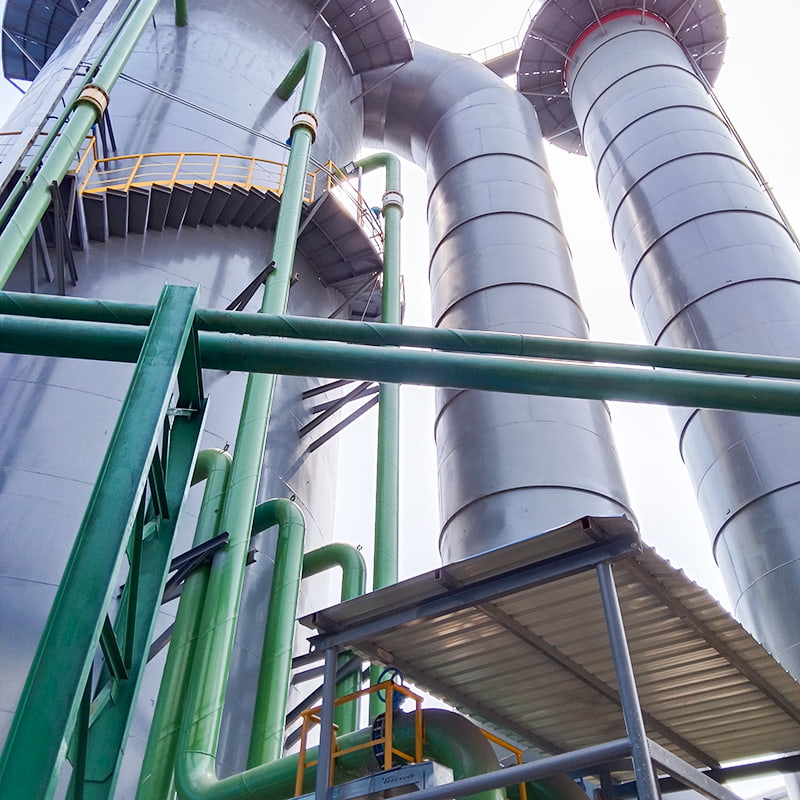 Wet Gravity Spray Dust Collector for High-Moisture Flue GasFirst-stage wet collector for dusty, high-moisture flue gas, using spray layers and a demister to remove coarse dust and heat before fine scrubbing.View Product →
Use a spray tower for coarse dust and cooling, a packed bed for acid gas absorption, a venturi for fine particulate at high pressure drop, and a wet electrostatic precipitator for submicron fumes and plume control. Particle size distribution and the outlet limit decide the stage; a larger pump cannot correct the wrong choice.
The pressure drop budget is where many designs become uneconomic. A venturi can capture fine particles, but it may consume 5-15 kPa, while a spray tower usually sits below 2 kPa. Fan power follows pressure drop, so the scrubber choice is also an energy decision.
For the finest fraction, wet electrostatic precipitator selection deserves close review. A wet ESP is a polishing stage, not a substitute for a well-operated pre-scrubber. It needs clean, saturated gas and a mist eliminator that protects the electrodes.
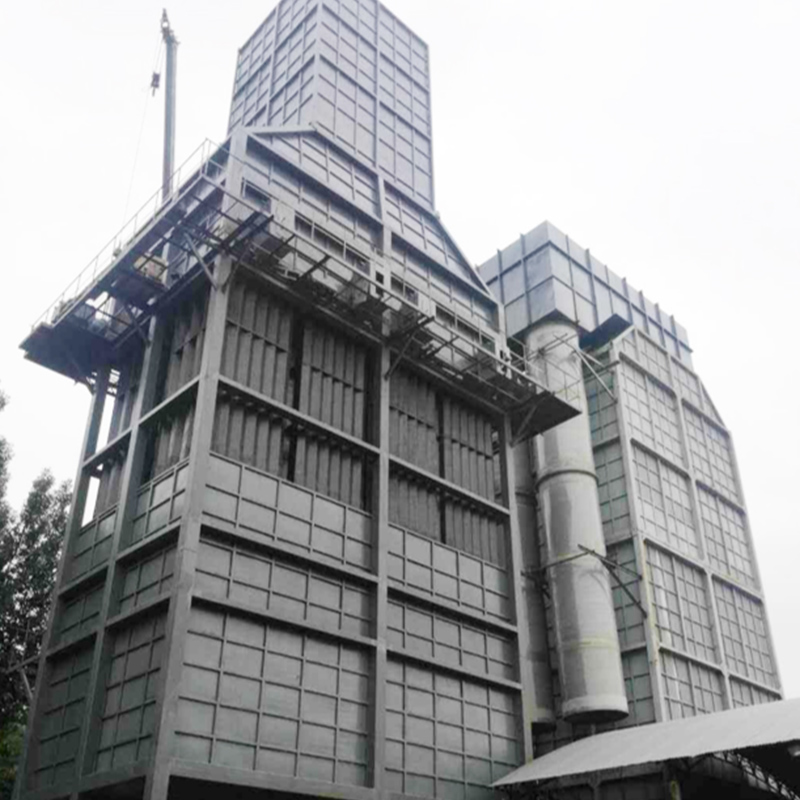 Vertical Honeycomb Wet Electrostatic Precipitator for Fine Dust PolishingCustom wet ESP with honeycomb anode tubes for fine dust and moisture removal, typically placed after wet desulfurization or dust removal as a polishing stage.View Product →
The recycle loop is sized by liquid-to-gas ratio, nozzle coverage, and turndown, not by a single pump curve. A spray stage may start at 2-8 L/m3, but the real number comes from nozzle count, spray angle, and distance to the vessel wall. The right flow through the wrong header creates dry zones and plugging.
Check nozzle overlap at the minimum and maximum gas rate.
Use a separate purge stream to control chloride and suspended solids.
Size the mist eliminator below 4 m/s face velocity, lower when liquid loading is high.
Material selection must follow a chloride and acid map, not a single alloy specification. Petroleum coke can contain sulfur, vanadium, nickel, and chloride, and scrubber water concentrates those species through evaporation and blowdown. The shell, internals, nozzles, and mist eliminator often need different materials.
Rubber-lined carbon steel for the shell in dilute acid service.
Duplex 2205 or 316L for wetted internals after chloride review.
Alloy C‑276 (UNS N10276) only in chloride‑rich zones where the map proves it is needed.
Commissioning should prove water balance, pH control, mist elimination, and pressure drop at three loads before the performance test. A scrubber that passes at 100% load but floods at 50% is not commissioned; it is merely running.
Flush the loop and verify nozzle coverage with clean water.
Establish pH control and automatic blowdown on conductivity.
Run 50%, 75%, and 100% load cases and log mist eliminator differential pressure.
Confirm stack opacity and fan power at each point.
Spray towers typically run below 2 kPa, packed absorbers around 1-3 kPa, venturis 5-15 kPa, and wet ESPs under 1 kPa. Select the stage from the particle size and outlet limit, then confirm the fan budget with guaranteed vendor data.
Yes, but it should be staged. A quench or spray section removes coarse dust and cools the gas, a packed or tray section absorbs SO2, and a mist eliminator protects the downstream equipment. A single empty vessel rarely meets both duties with stable turndown.
Chloride concentrates in the recycle water and drives pitting and stress corrosion cracking. Automatic blowdown, conductivity monitoring, and a chloride map for wetted materials are more reliable than annual visual inspection.